3 studies with real participants · 2 executed workshops · 3 proposals · 1 ethics credential
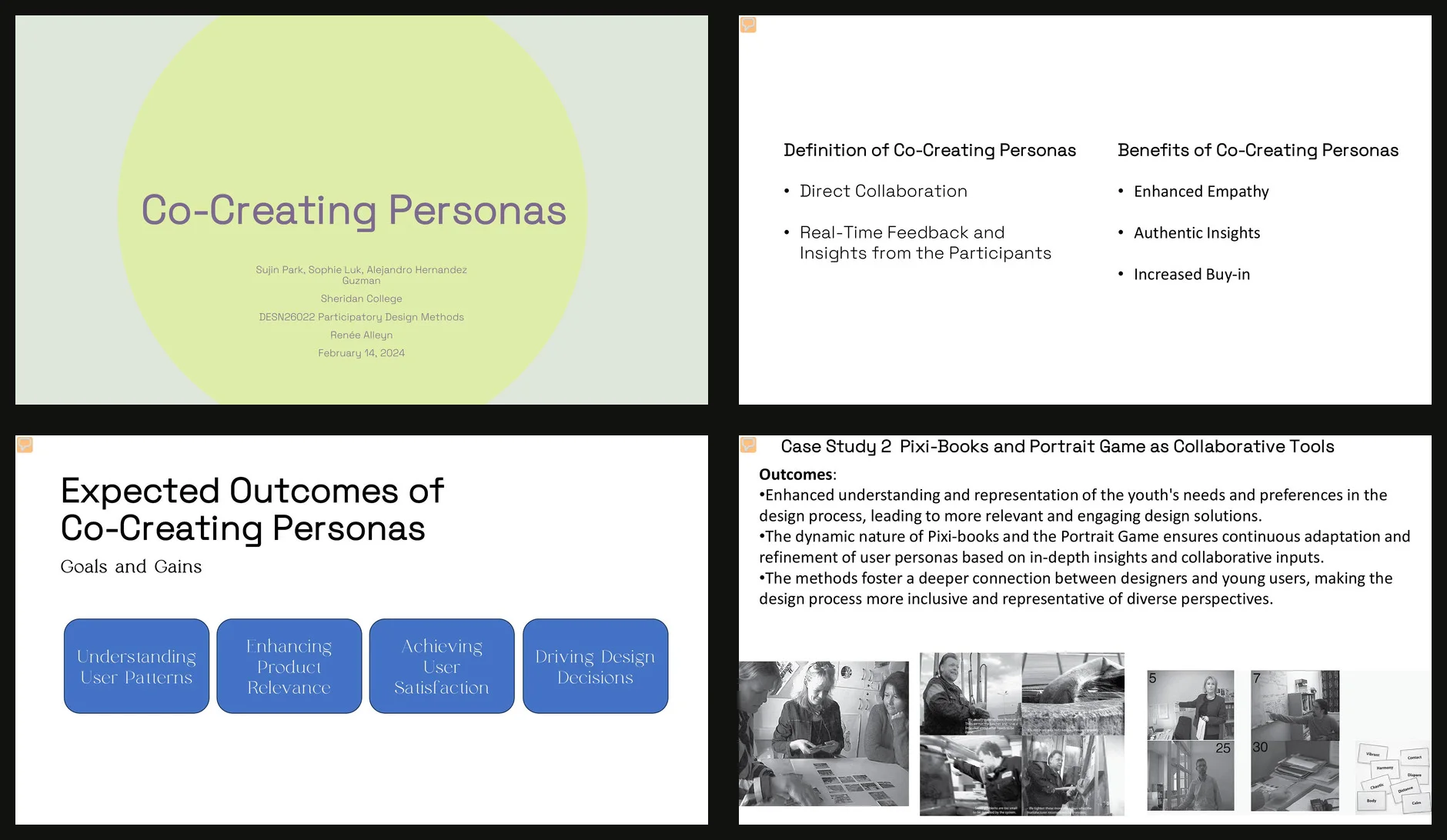
Co-creating personas seminar: definitions, benefits, outcomes and cases · Participatory-design methods seminar
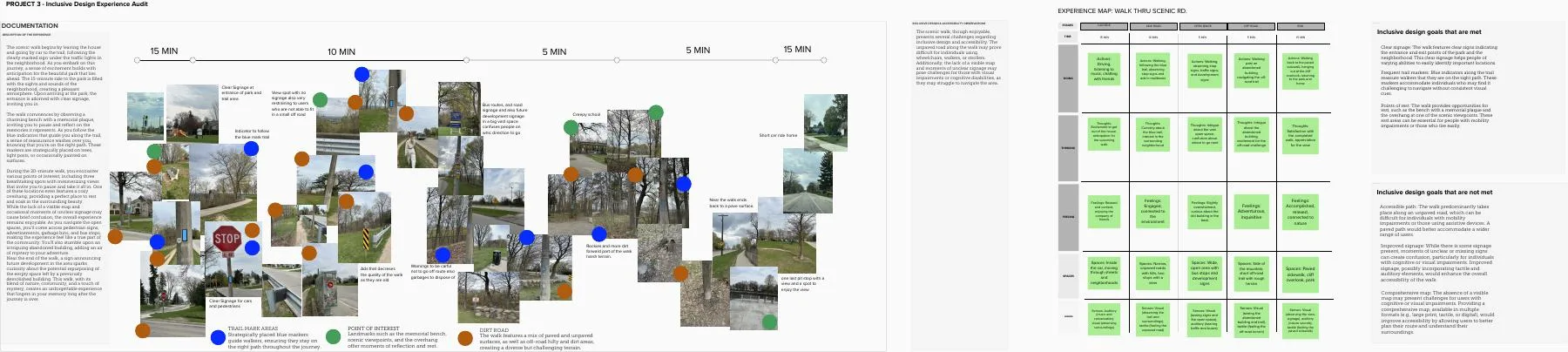
Early accessibility observation and journey study · Research-methods exercise
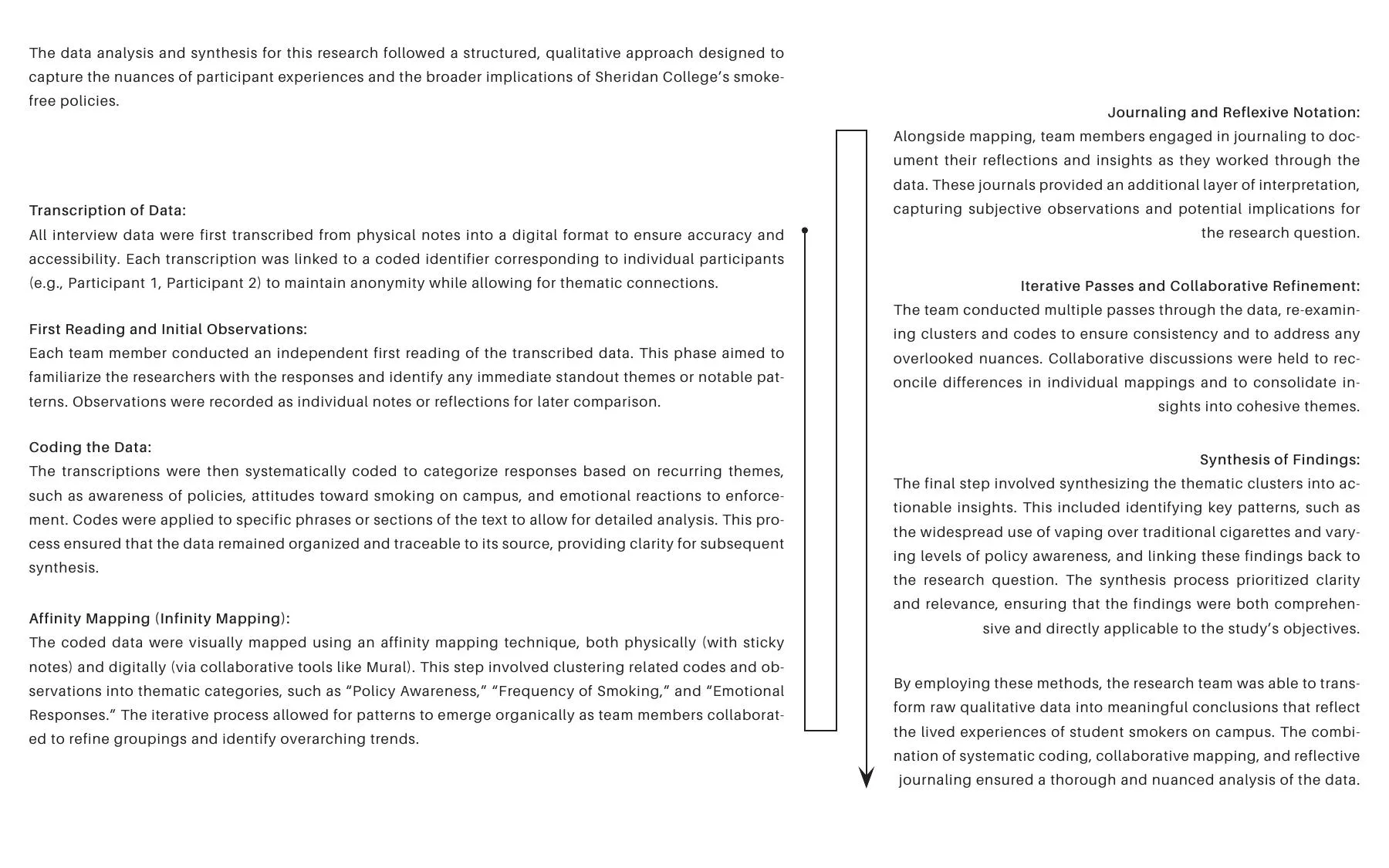
From transcripts to coded themes and affinity mapping · Analysis and synthesis plate
Project status
Five learning environments · Eight evidence records · Executed studies, applied exercises and clearly labelled proposals
Project boundary. This is a research archive — not a claim of commissioned, built, tested, or approved work beyond what each record documents.
My contribution
Research planning, ethical preparation, participant recruitment, contextual interviews, field observation, workshop co-facilitation, synthesis, reporting and reflection.
One practice · several learning environments
Research is a path, not a single project.
This atlas shows where each method entered my practice, what I did with it, what came out and where the evidence stops. Course learning, executed participant work, proposals, concept artifacts and thesis inquiry remain visibly distinct.
TCPS 2 ethics
Contextual interviews
Participant recruitment
Consent and confidentiality
Observation
Co-creating personas
Facilitation
Generative toolkits
Transcription
Coding
Affinity mapping
Descriptive counts
Journey mapping
Accessibility audit
Research through design
2023–2026 · course provenance
Where I learned it. Where I used it.
Five course environments build from research foundations to facilitation, applied qualitative inquiry, experience strategy and research through design.
01Winter 2023
Research Methods for Experiential Design
LearnedResearch types, ethical practice, source evaluation, structured and unstructured interviews, case-study analysis, observation and proposal writing.
AppliedInterview method study, campus wellness research proposal and an inclusive-design experience audit.
Research ethics
Interviews
Observation
Case analysis
Proposal writing
02Winter 2024
Participatory Design Methods
LearnedCo-creation mindsets, ethics and recruitment, facilitative listening, generative sessions, group decision-making, documentation and co-synthesis.
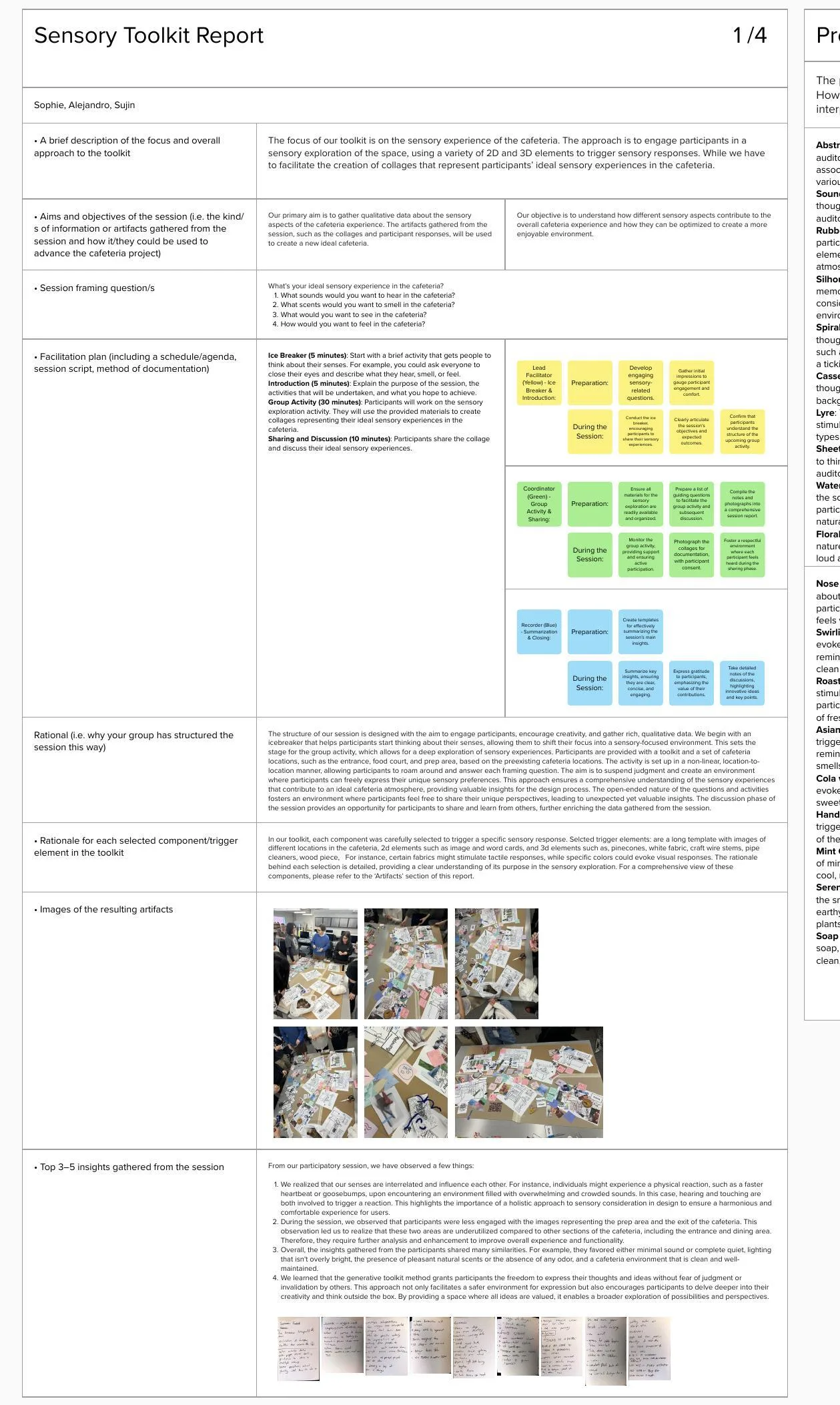
AppliedCo-creating Personas seminar, cafeteria sensory toolkit and Morrison Creek Valley workshop plan.
Co-creating personas
Facilitation
Generative toolkits
Recruitment
Co-synthesis
03Fall 2024
Research Methods for XD II
LearnedFraming research questions, selecting methods, SREB preparation, consent, recruitment, contextual interviews, transcription, coding, affinity mapping and limitations.
AppliedSmoke-Free Sheridan policy study with six student participants who vape; Alejandro conducted four interviews.
Contextual inquiry
Consent
Coding
Affinity mapping
Descriptive counts
04Fall 2024
Social Experiences
LearnedAudience modelling, before/during/after flows, content ecosystems, touchpoint planning and performance measures for an experiential concept.
AppliedTwo PlayStation Dreamscape concept personas, an experience flow and a cross-platform content strategy. These were not participant-validated.
Concept personas
Journey mapping
Touchpoints
Content strategy
Metrics planning
052025–2026
Thesis Theory + Thesis Studios
LearnedLiterature synthesis, precedent research, systems thinking, research through design, futures framing, discursive design, diegetic prototyping and ethical positionality.
AppliedHamilton 2092 translated research into speculative artifacts, a guidebook, exhibition media and a public digital world.
Personas are stronger when people help build them.
Our Participatory Design Methods presentation asked what changes when a team creates personas with people instead of describing them from a distance.
What the presentation established
Co-creating personas brings participants into the interpretation process. The method combines shared stories, real-time feedback and facilitated making to surface needs, context and disagreement that an expert-only persona can flatten.
When to use it
Early discovery, service reframing and moments when a team needs a shared view of lived experience.
How it works
Recruit relevant participants, frame a respectful activity, build the persona together, compare interpretations and confirm what the group recognizes as accurate.
What it produces
A working representation, visible assumptions, stronger participant ownership and questions the next research round still needs to test.
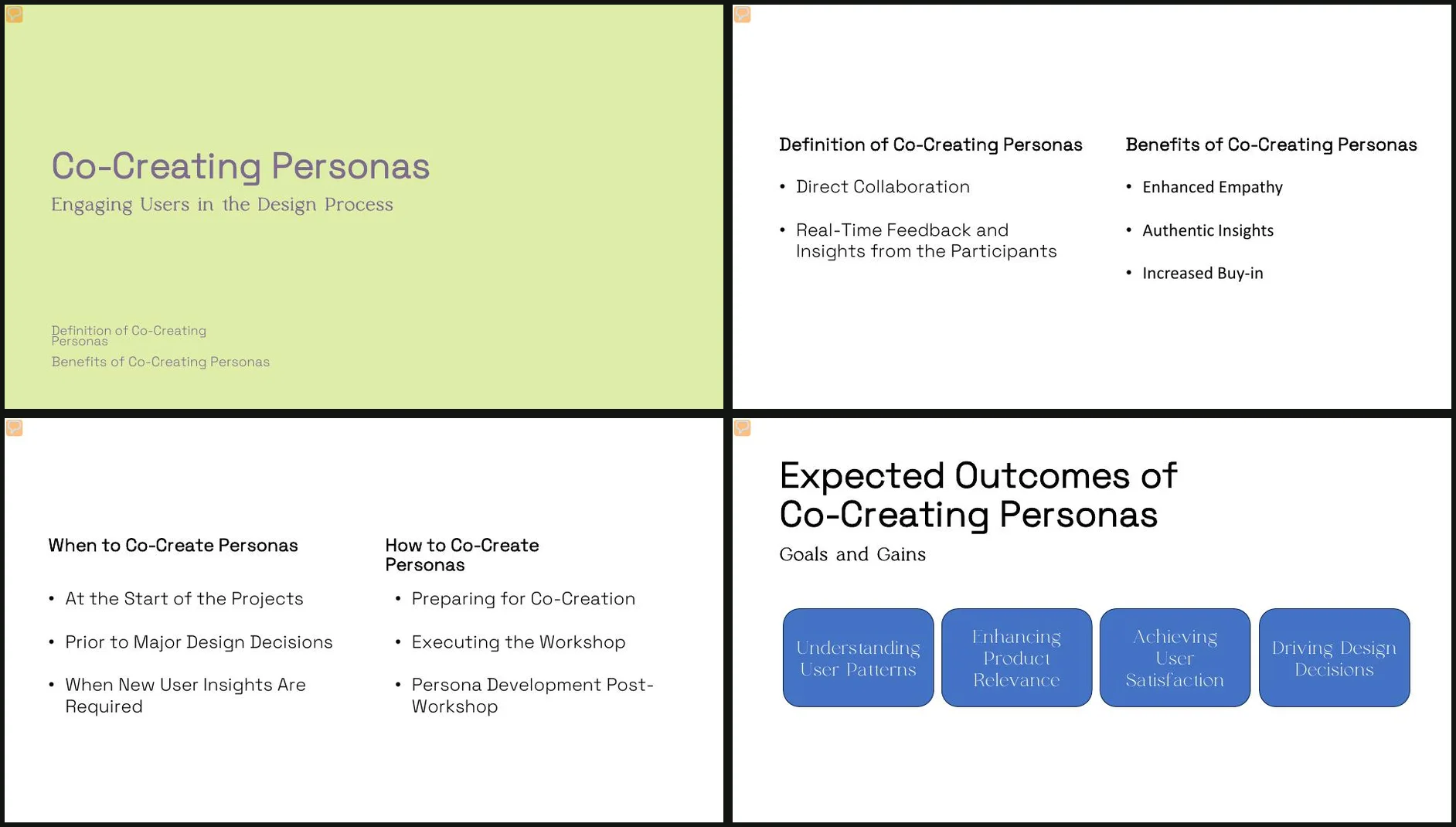
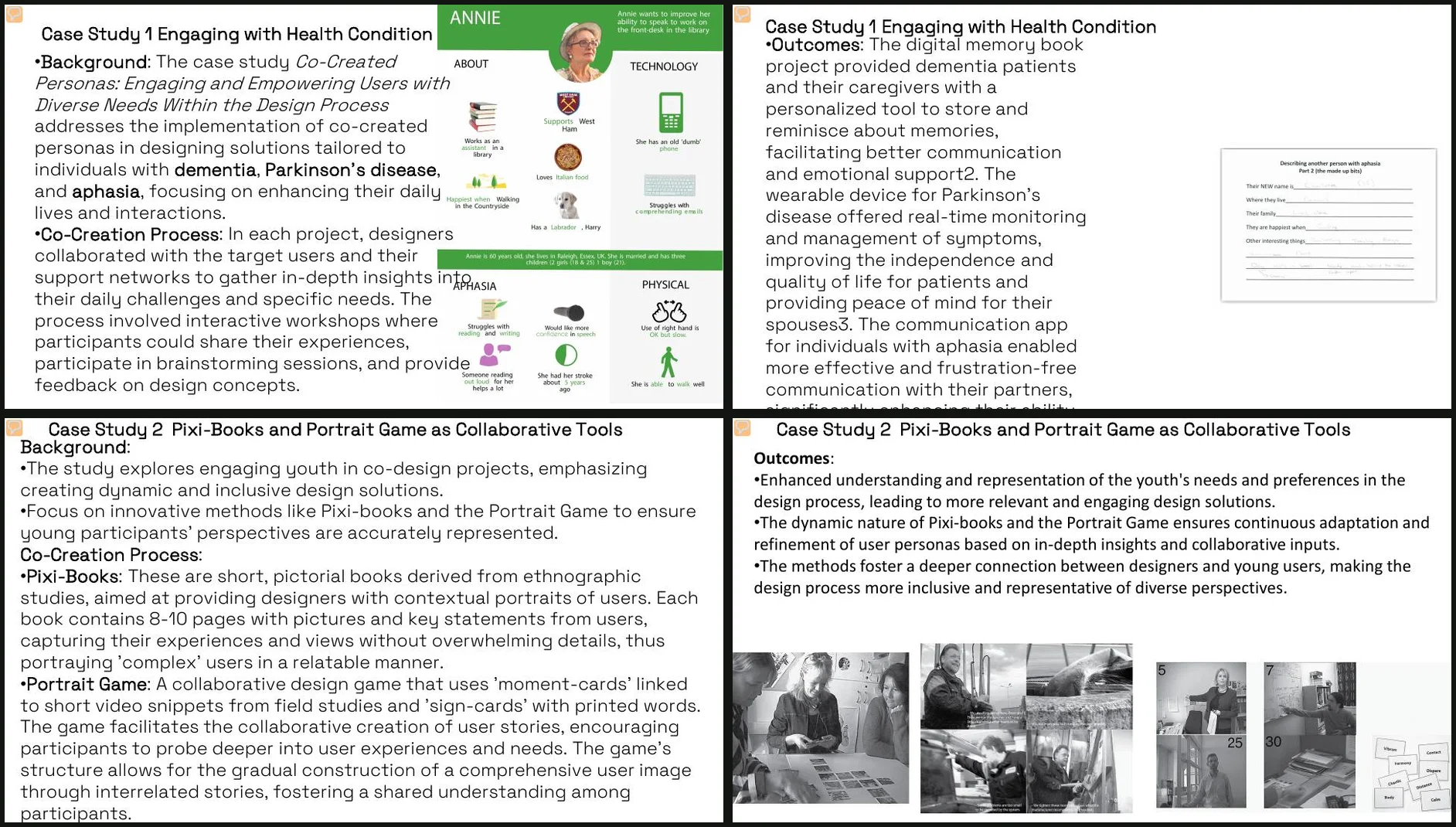
Co-creating personas seminar: definition, value, timing and workshop method · Participatory-design method sequence
Co-creating personas seminar: health and youth co-design case studies · Evidence and case comparison
Co-creating personas seminar: definitions, benefits, outcomes and cases · Participatory-design methods seminar
This was a research-backed methods seminar by Sujin Park, Sophie Luk and Alejandro Hernandez Guzman. The health and youth examples were case studies we analyzed; they were not workshops we personally conducted. The learning later informed our proposed Morrison Creek co-design activities.
Eight records · multiple evidence levels
The research practice library.
Open a record for its objective, inputs, methods, outcomes and limits. The badge colour tells you whether the work was executed, observed, proposed, learned or conceptual.
From transcripts to coded themes and affinity mapping · Analysis and synthesis plate
01Fall 2024
Executed group study
Smoke-Free Sheridan policy research
A complete line from policy context and recruitment to interviews, transcripts, themes and responsible next steps.
Learned in · Research Methods for XD II
6 participants
4 interviews by Alejandro
Consent
Coding
Affinity mapping
Objectives, inputs and outcomes +
Objective
Understand how the absence of designated smoking areas and policy enforcement shaped student smokers’ awareness, behaviour and sense of fairness.
Inputs
Sheridan’s smoke-free policy, public-health literature, campus observations and a defined set of research questions.
Participants
Six student vapers recruited through convenience sampling. About half of the people approached declined. The sample is not statistically representative.
My contribution
Research planning, four interviews, transcription, coding, affinity mapping, analysis, reporting and presentation organization.
Outcome
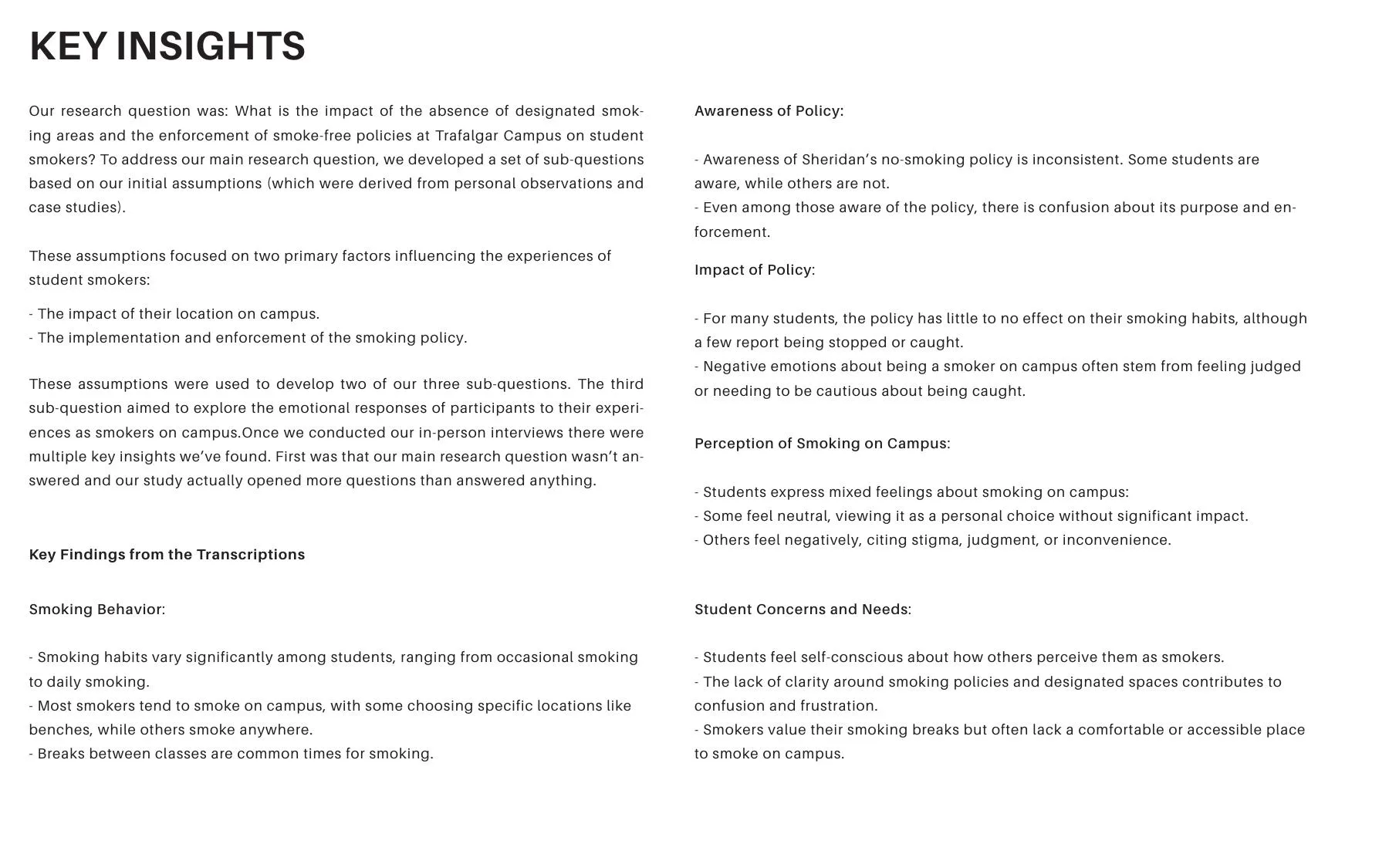
Awareness was inconsistent, enforcement did not reliably change behaviour, and confusion and stigma appeared in participant accounts.
Next step
Test clearer policy communication with a larger, more diverse sample and pair deeper interviews with a properly powered survey.
Participants preferred quieter sound, softer light, natural or absent scent and cleanliness; underused areas needed further investigation.
Learning
Creative prompts can reach ideas a direct question misses, but facilitation must support expression without steering it.
Early accessibility observation and journey study · Research-methods exercise
03Winter 2023
Applied observation exercise
Inclusive scenic-walk audit
The audit identified strengths in markers and rest points alongside barriers in unpaved terrain, inconsistent signs and the absence of a comprehensive map.
Learned in · Research Methods for Experiential Design
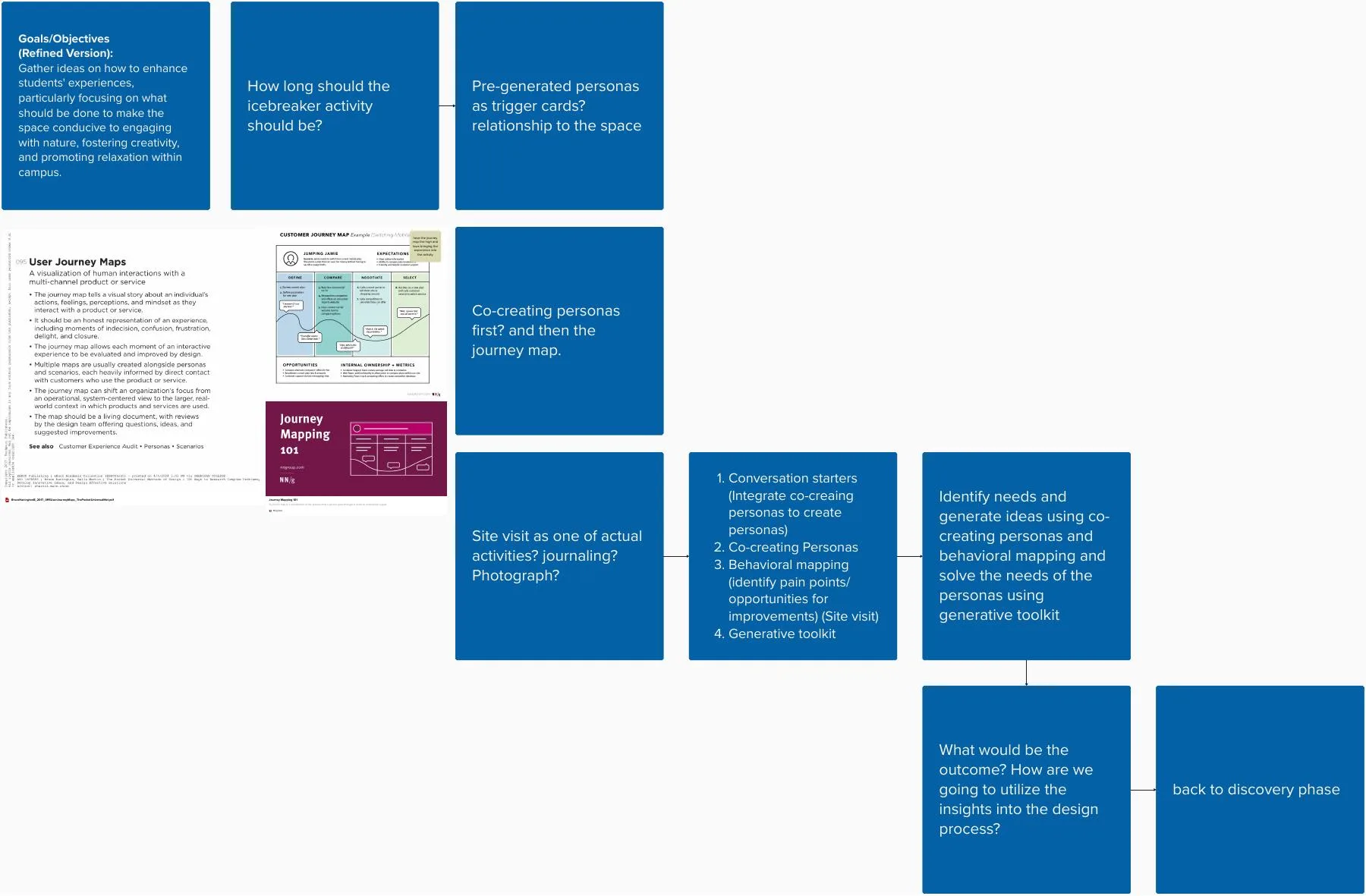
Morrison Creek Valley co-design workshop plan · Proposed workshop plan
04Winter 2024
Workshop proposal
Morrison Creek Valley co-design plan
A full discovery-workshop plan connecting recruitment, facilitation, field activity, making and co-synthesis.
Learned in · Participatory Design Methods
Purposive sample
Facilitator script
Behavioural mapping
Generative toolkit
Co-synthesis
Objectives, inputs and outcomes +
Objective
Plan a discovery workshop around nature engagement, creativity and relaxation in a campus valley.
Proposed participants
Sixteen students across eight relevant programs, recruited purposively through Sheridan channels.
Activities
Cue-card conversations, co-created personas, site-based behavioural mapping, generative making, group presentations and feedback.
Outputs
Participant agenda, facilitator script, activity materials, documentation plan and analysis framework.
Learning
Recruitment, inclusion criteria, timing, accessibility, documentation and synthesis must be designed with the same care as the activity.
Boundary
The workshop was planned and critiqued in class; it is not represented as delivered fieldwork.
Co-creating personas seminar: definitions, benefits, outcomes and cases · Participatory-design methods seminar
05Winter 2024
Group methods seminar
Co-creating personas evidence review
A research-backed presentation examined when personas should be created with people rather than written about them.
Learned in · Participatory Design Methods
Literature review
Co-creation
Persona development
Case comparison
Inclusive participation
Objectives, inputs and outcomes +
Question
What changes when people help construct the personas used to represent their lives and needs?
Inputs
Persona literature, participatory-design sources and case studies involving dementia, Parkinson’s disease, aphasia and youth co-design.
What we presented
Definitions, timing, workshop steps, benefits, limitations, expected outcomes and two method case studies.
Outcome
The seminar connected direct collaboration and real-time feedback with stronger empathy, more authentic insight and participant buy-in.
Application
The learning informed the proposed persona activity in the later Morrison Creek workshop plan.
Boundary
This record demonstrates method learning and evidence review, not a persona workshop facilitated by the presentation team.
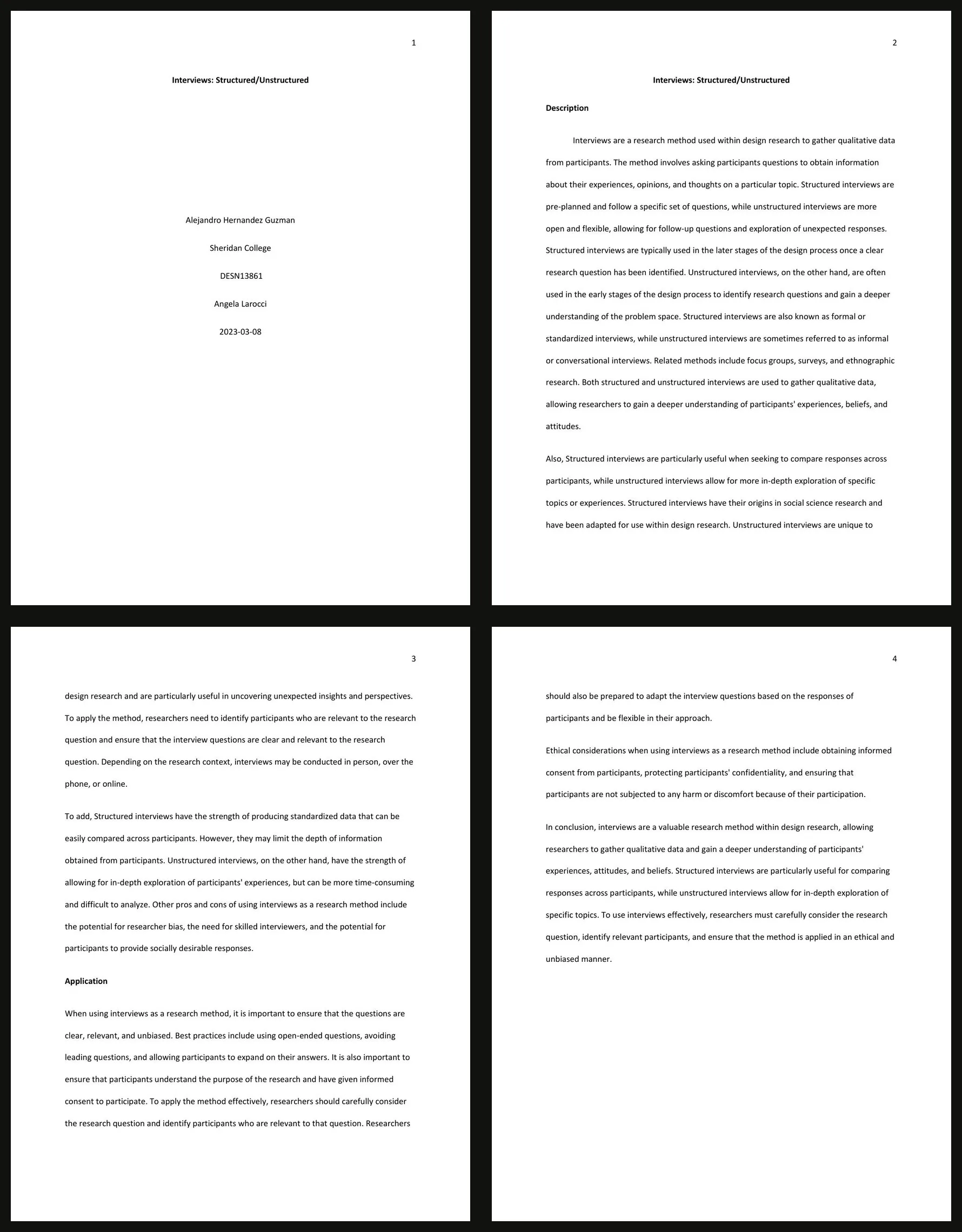
Structured and unstructured interview method study · Individual research-methods paper
06Winter 2023
Individual method study
Structured and unstructured interviews
An early methods paper compared interview structures, applications, trade-offs, bias and ethical responsibilities.
Learned in · Research Methods for Experiential Design
Method comparison
Open questions
Bias awareness
Informed consent
Confidentiality
Objectives, inputs and outcomes +
Learning objective
Understand when standardization supports comparison and when open conversation supports discovery.
Topics
Question design, participant relevance, leading questions, follow-up prompts, researcher bias, social-desirability bias and analysis trade-offs.
Ethics
Informed consent, confidentiality and avoiding participant harm or discomfort.
Outcome
A written method reference that later informed contextual interviewing in the smoke-free policy study.
Learning
A flexible interview is not an improvised conversation; it still requires a clear research question, ethical preparation and disciplined listening.
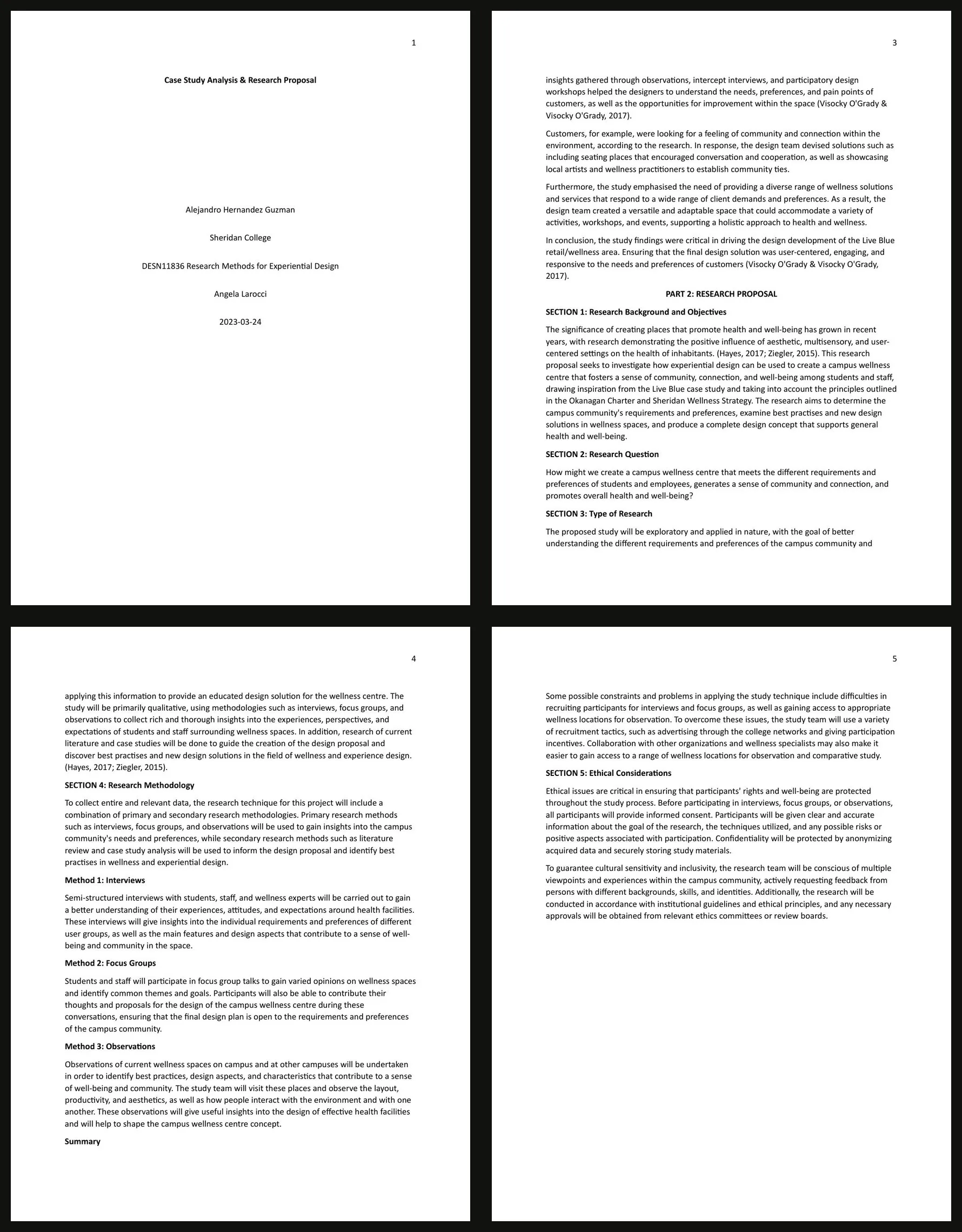
Campus wellness case analysis and research proposal · Individual exploratory research proposal
07Winter 2023
Individual research proposal
Campus wellness research proposal
A case-study analysis became an exploratory proposal for a more connected and supportive campus wellness centre.
Learned in · Research Methods for Experiential Design
Case-study analysis
Research question
Semi-structured interviews
Focus groups
Observation
Objectives, inputs and outcomes +
Question
How might a campus wellness centre support different needs, community connection and overall well-being?
Inputs
Live Blue case analysis, wellness-space literature, the Okanagan Charter and Sheridan’s wellness strategy.
Proposed methods
Semi-structured interviews with students, staff and wellness experts; focus groups; observation; literature review and precedent comparison.
Ethics
Consent, confidentiality, anonymized data, secure storage, cultural sensitivity and institutional review.
Outcome
A documented exploratory methodology with anticipated recruitment and access constraints.
Boundary
The proposal was not implemented and contains no participant findings.
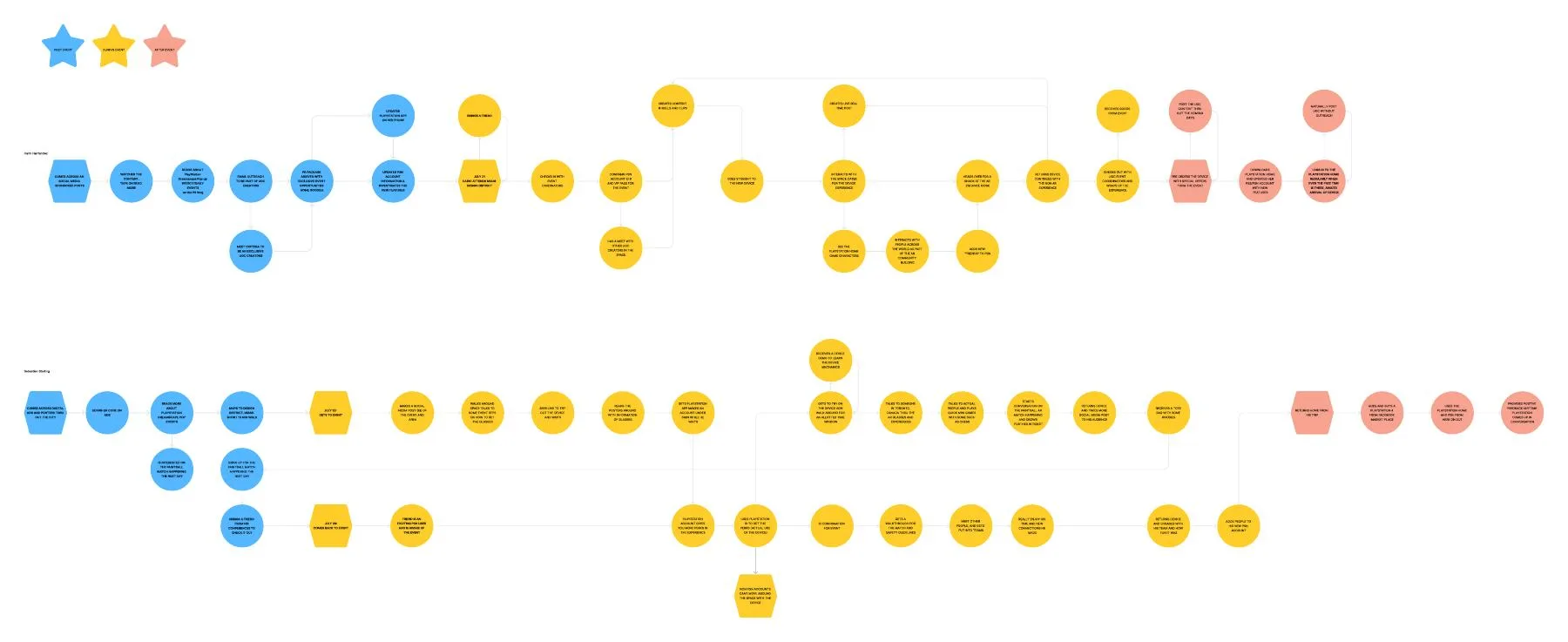
PlayStation Dreamscape before, during and after experience flow · Concept journey map · not participant-validated
08Fall 2024
Concept strategy artifacts
PlayStation personas and experience flow
Two audience hypotheses were translated into before, during and after touchpoint flows and a content ecosystem.
Learned in · Social Experiences
Concept personas
Journey mapping
Service touchpoints
Content strategy
Metrics plan
Objectives, inputs and outcomes +
Objective
Practice turning audience context and touchpoints into an actionable social-experience concept.
Inputs
Secondary brand and platform research, comparable experiences, concept assumptions and an event brief.
Outputs
Two persona narratives, activity flows, channel strategy, content cadence and proposed performance measures.
Outcome
The artifacts exposed where outreach, account setup, on-site participation, rewards and post-event content needed continuity.
Learning
Personas and journeys are most useful when they reveal what a team still needs to validate.
Boundary
The personas are fictional strategy artifacts, not participant-validated customer segments.
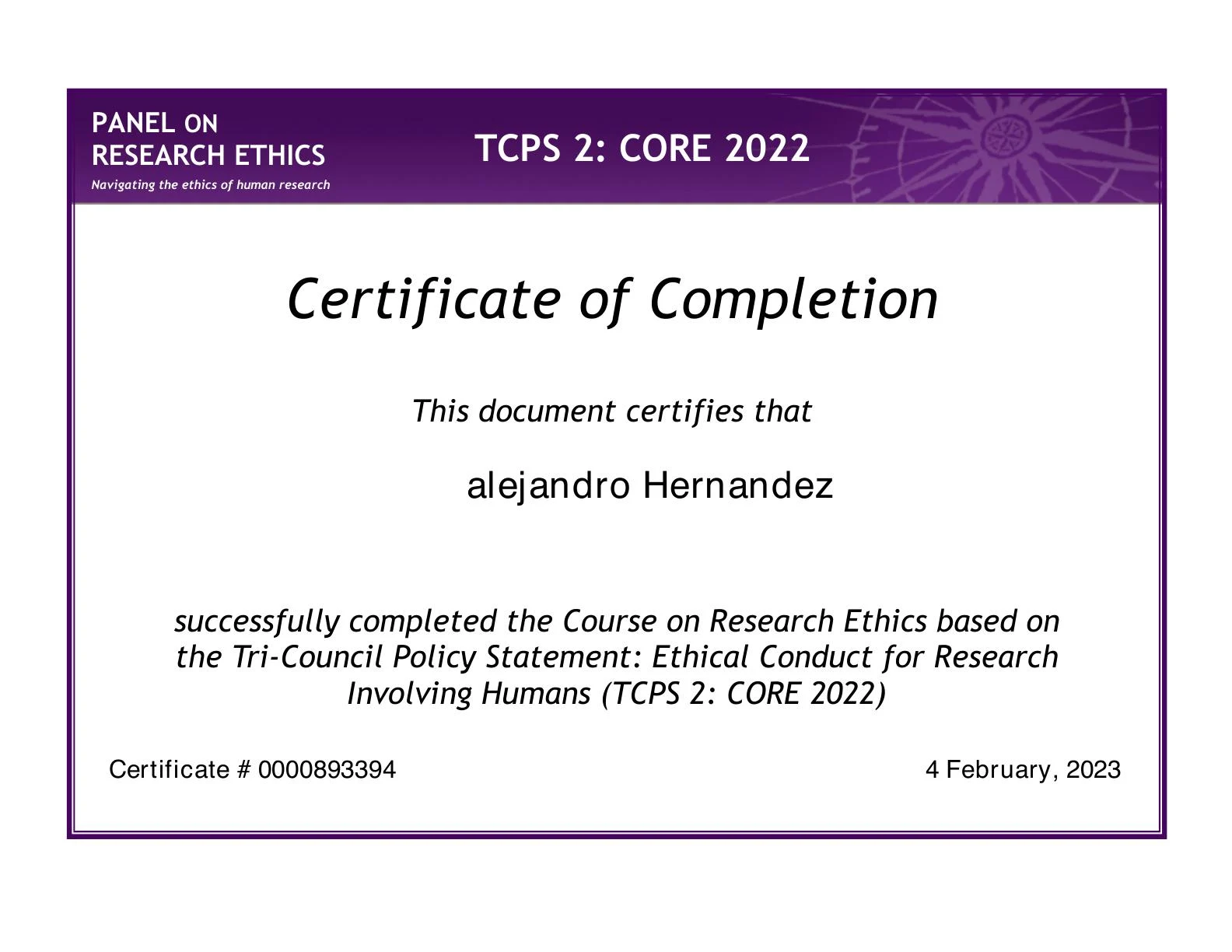
TCPS 2 CORE 2022 certificate of completion for Alejandro Hernandez · Research ethics credential · completed February 4, 2023
Verified credential
TCPS 2: CORE 2022
Completed February 4, 2023
Training in the ethical conduct of research involving humans, including respect for persons, concern for welfare and justice. Later coursework applied these foundations through consent, voluntary participation, coded identifiers, withdrawal language, de-identification and planned data storage.
Human research ethics
Consent
Privacy
Participant welfare
Evidence in practice
From raw material to a defensible next step.
The policy study follows a visible line from research questions and recruitment through interviews, transcripts, codes, themes and recommendations.
Policy-awareness findings from six student participants who vape · Findings plate
Judgment in practice
Limitations are part of the result.
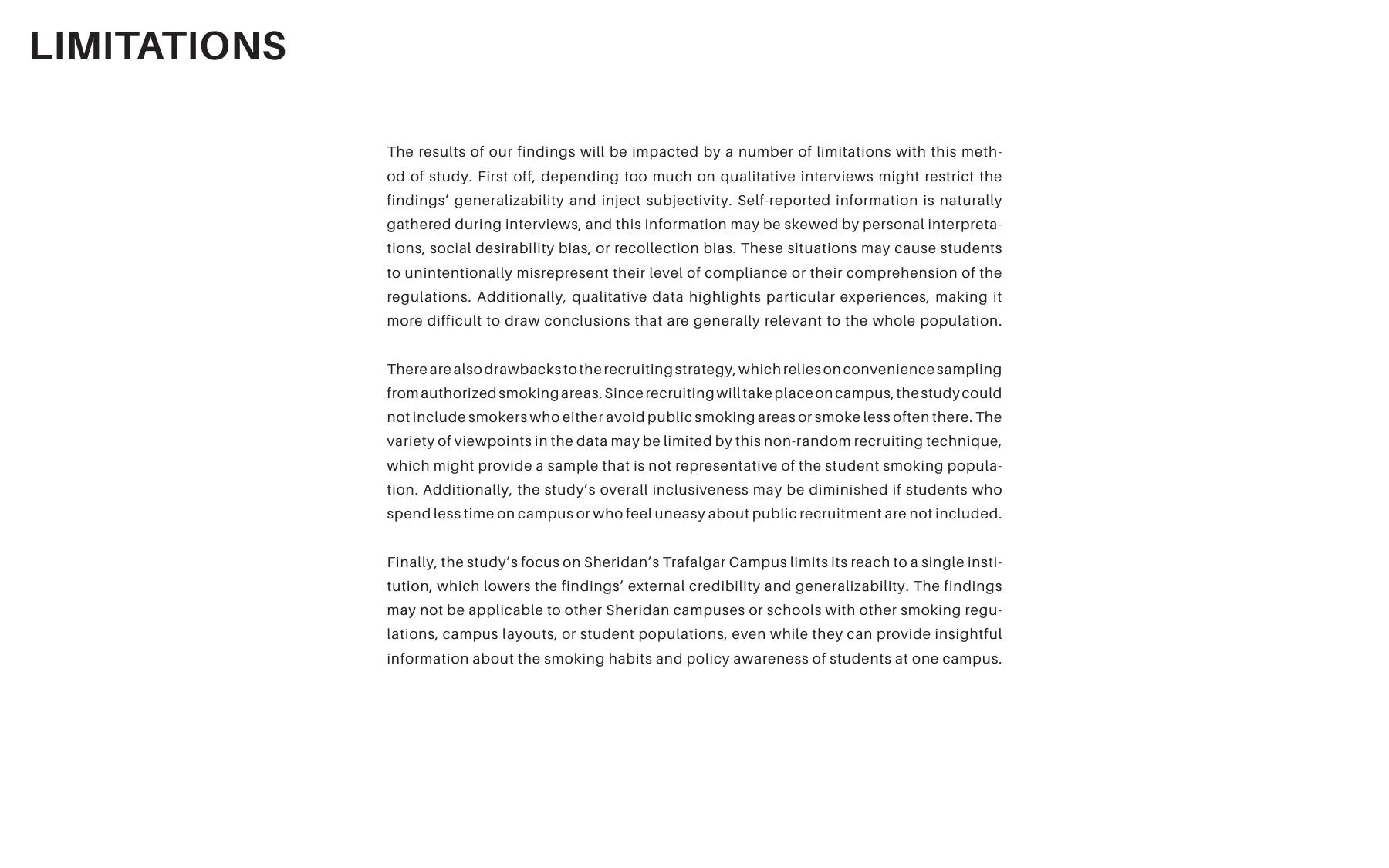
Convenience sampling, six short interviews and a vape-only participant group generated useful questions—not universal conclusions.
Sampling and generalizability limitations · Research limitations
What this archive demonstrates
Applied academic practice.
Ethical preparation, interview planning, field observation, participant facilitation, qualitative synthesis, descriptive counts, persona and journey development, critical inquiry and the ability to turn incomplete evidence into a responsible next move.
Scope of this archive
Keep the boundary visible.
This archive does not establish three years of professional customer-research employment, representative quantitative analysis, executive facilitation or implemented policy impact. Proposals, concept personas and executed participant studies are labelled separately.
What I would develop next
Move from coursework into a durable research repository.
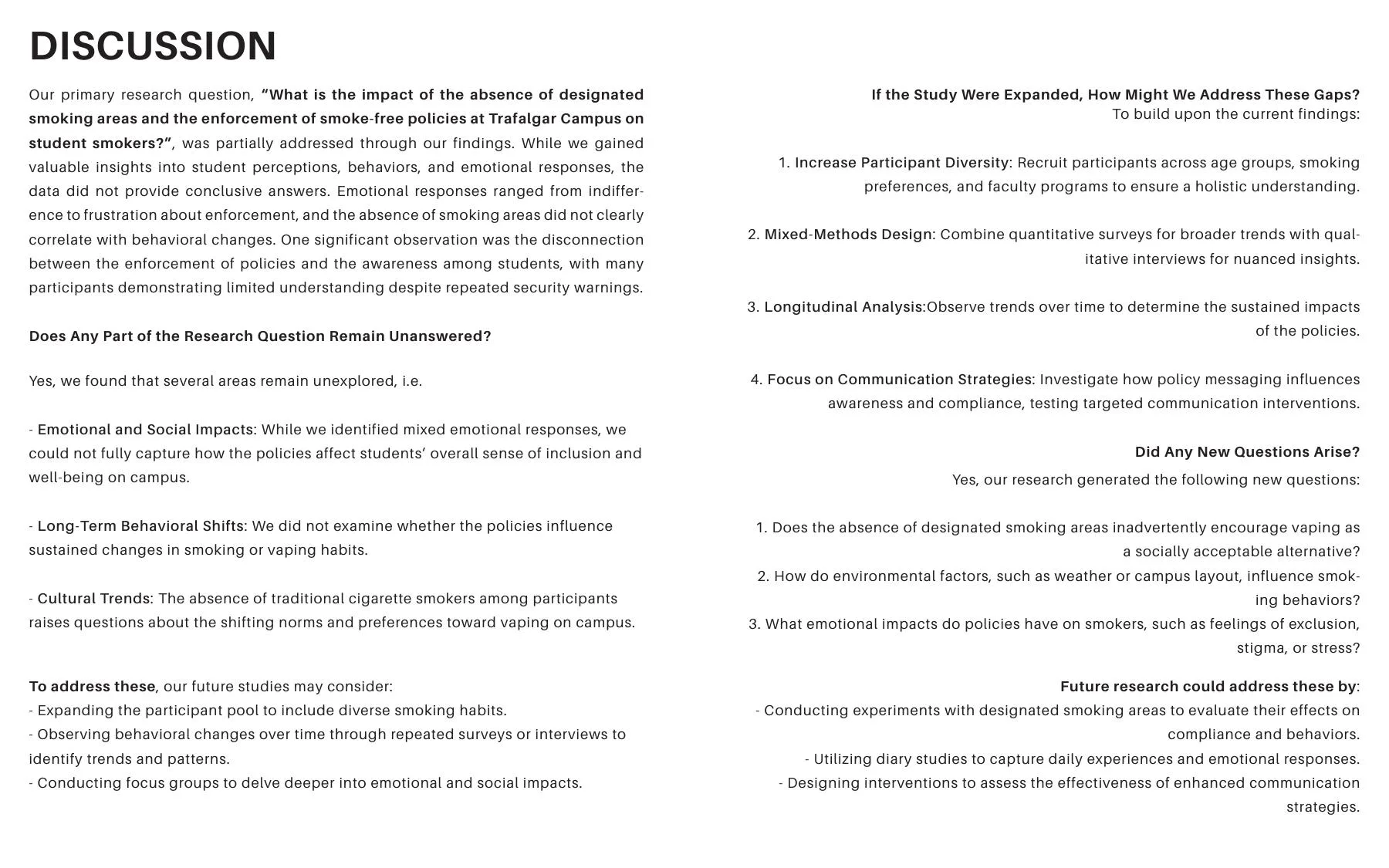
Repeat the policy study with a larger and more diverse sample, pair interviews with a properly powered survey, test revised policy communication, and track whether recommendations change comprehension or behaviour.
Next-study recommendations and unanswered questions · Research recommendations
Tools with a purpose.
Interview guides and consent forms
Structured the contextual interviews and recorded informed consent.
Transcription workflow
Turned recorded interviews into text that could be coded.
Manual coding and affinity mapping
Grouped interview evidence into themes by hand.
Miro and Figma synthesis boards
Laid out themes, personas and journeys for review.
Where AI enters the process.
No AI transcription or synthesis used in the executed studies; AI use (if any) disclosed per record.
AI use across these course records: none verified in the reviewed sources; methods shown are human-executed unless a record says otherwise.