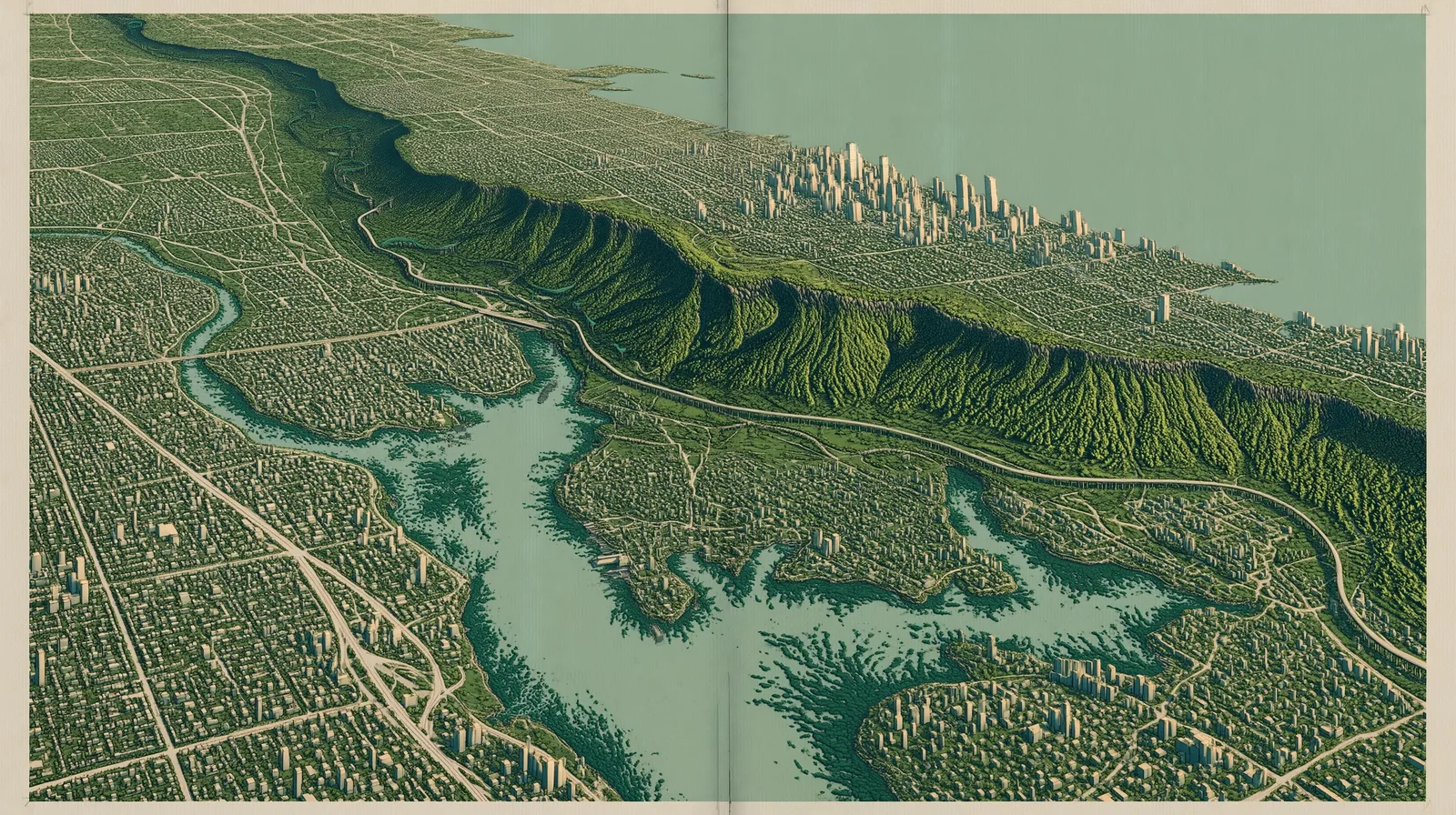
City overview. A bird’s-eye brief specified the escarpment, harbour, remediated industrial zones and rail spine before the image entered the guidebook.
Speculative design · Publication · Artifacts · Digital world
A future city you can enter, read, hold and question.
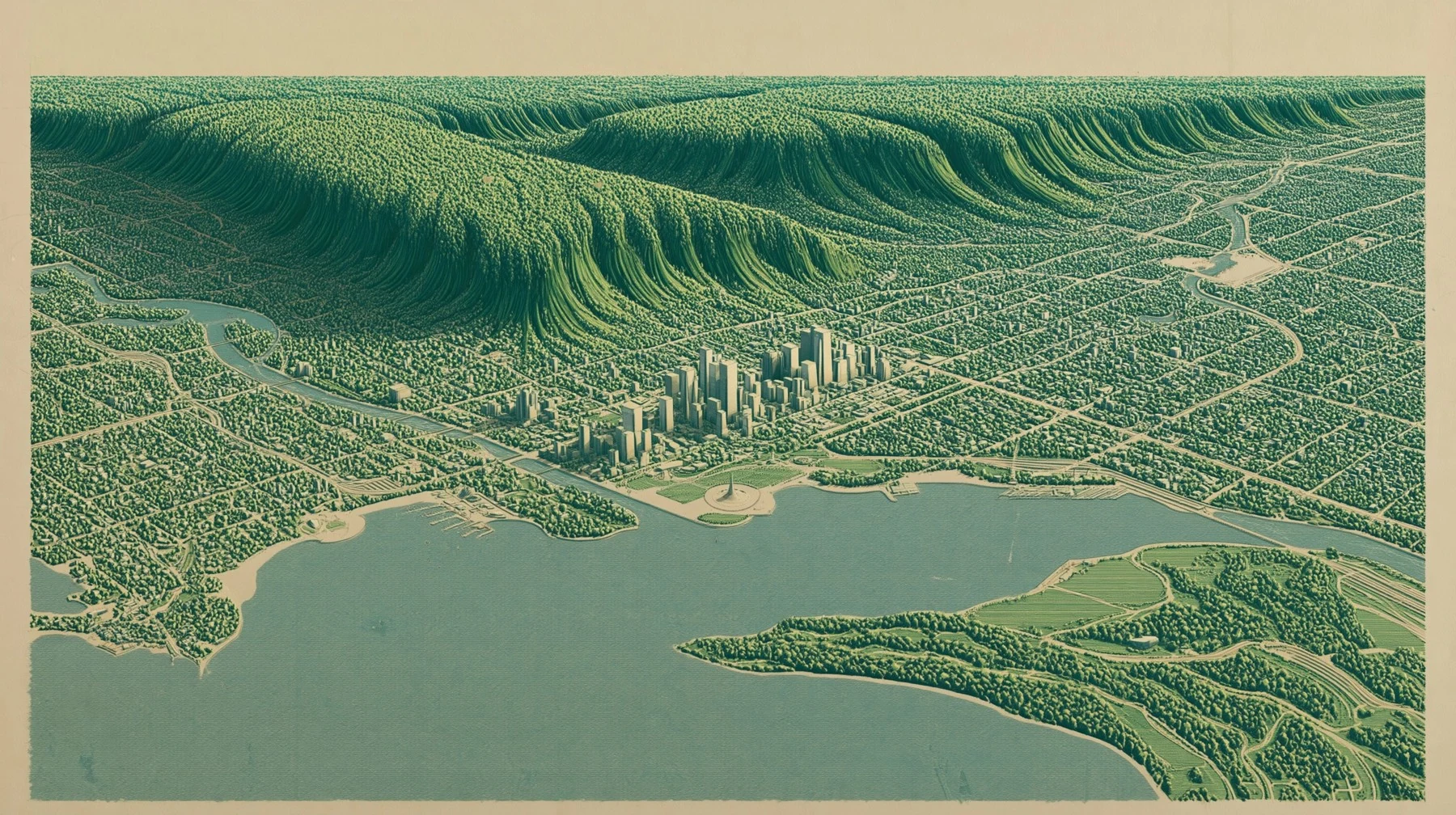
Project status
Independent capstone · Speculative world, publication and built studies · 2026
My contribution
Research, world-building, publication, digital experience and artifact design.
The proposition
Hamilton 2092 asks how a post-industrial city might feel if care, ecological repair and public life shaped its systems. Instead of presenting one distant image of “the future,” I built a connected world that can be read as a city, held as an object, watched as a film and entered online.
The work begins with present-day pressures and turns them into a designed proposition: an illustrated civic guide, a map and transit language, three speculative artifacts, an interactive website and an exhibition loop.
Project boundary. This is an independent speculative proposal—not commissioned planning for the City of Hamilton. Dates, services and technologies are fictional. Built models, technical concept art and generated visualizations are identified separately throughout.
Choose a chapter
Start with the finished world or move backward into the evidence. Every chapter has one job and a direct anchor.
01 / Research library
The project is grounded in municipal climate and stormwater plans, Hamilton urban-design and transit research, field observation, an 87-source bibliography and a reading shelf spanning speculative design, technology, ecology and architecture.
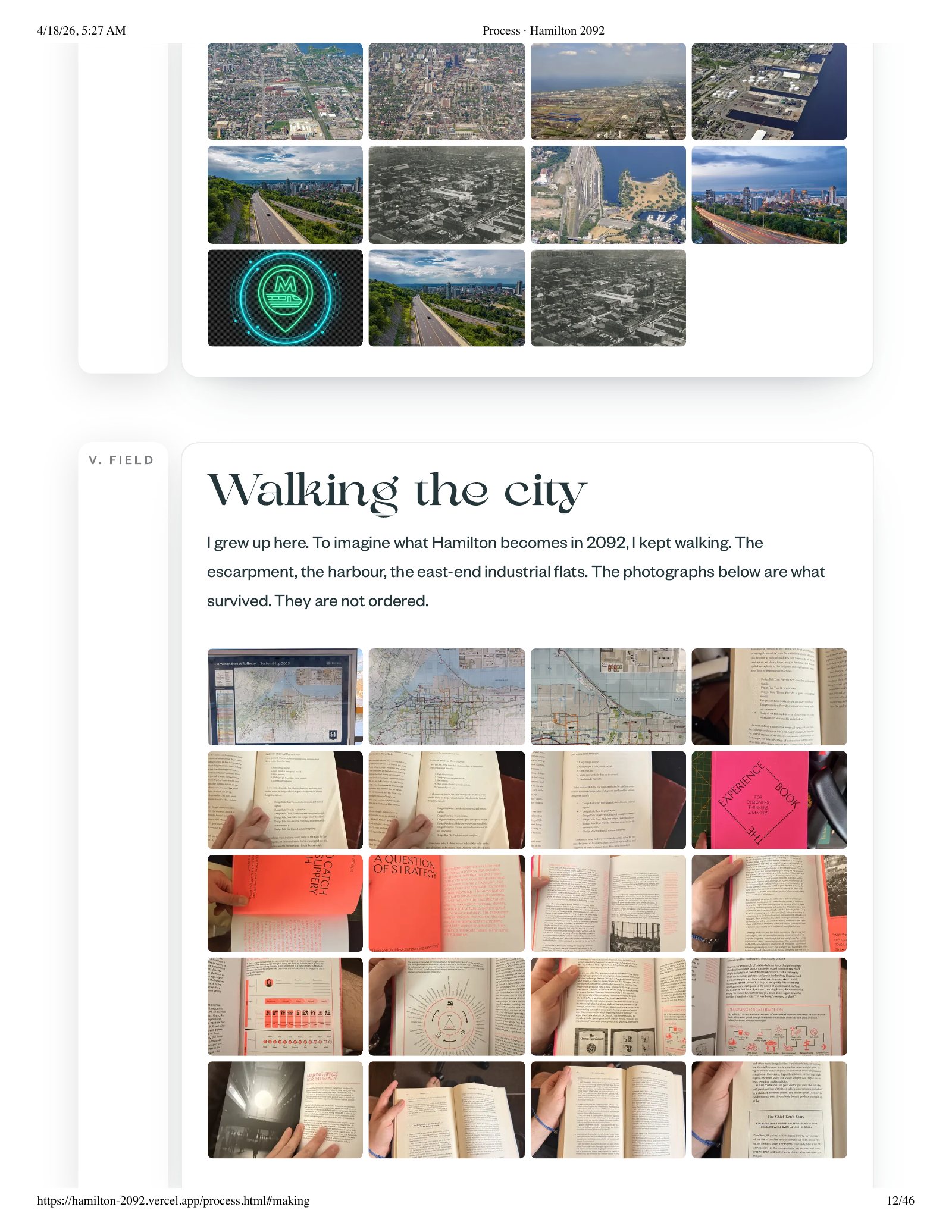
Walking the harbour, escarpment and city made place-specific evidence part of the method.
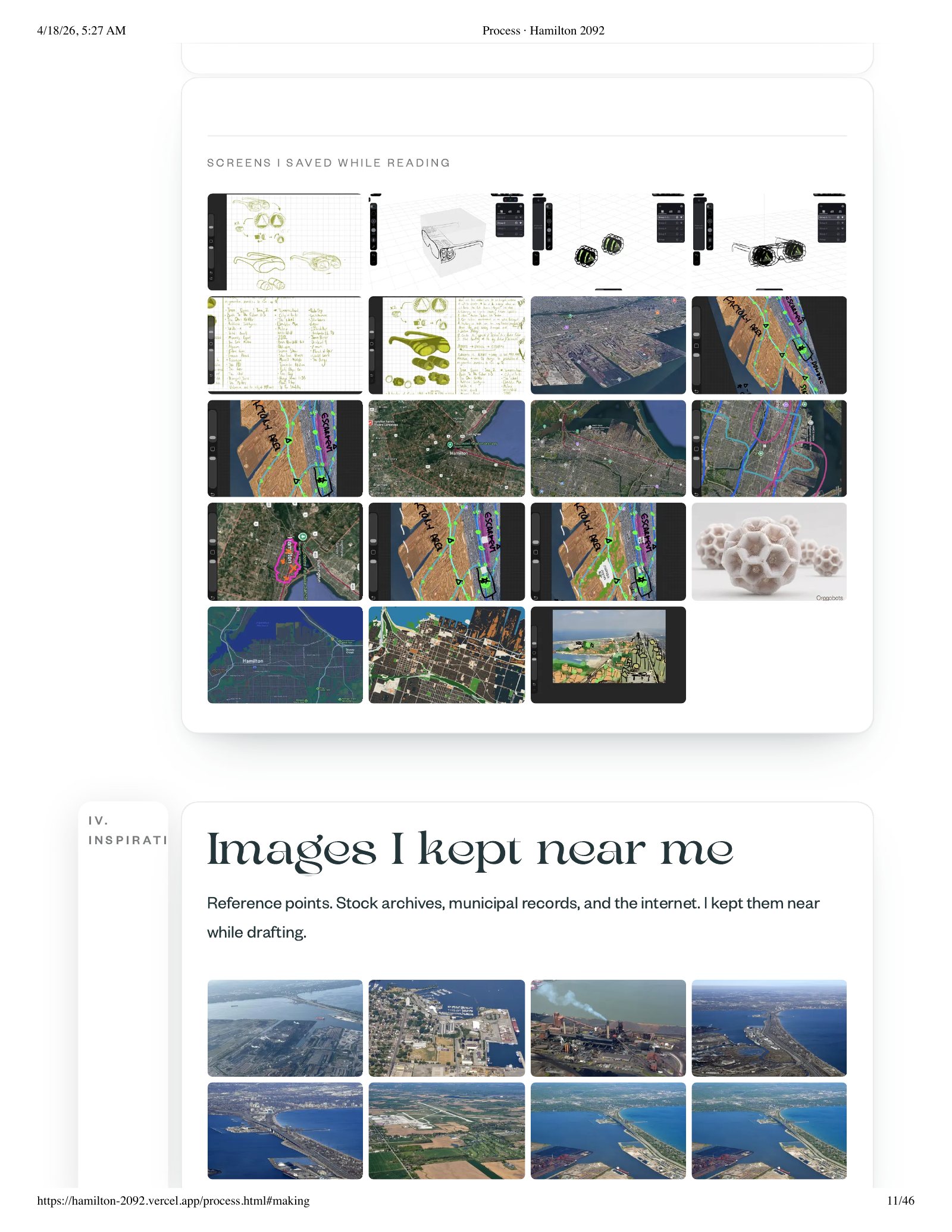
A visual reference wall held landscape, infrastructure, material and atmospheric cues together.
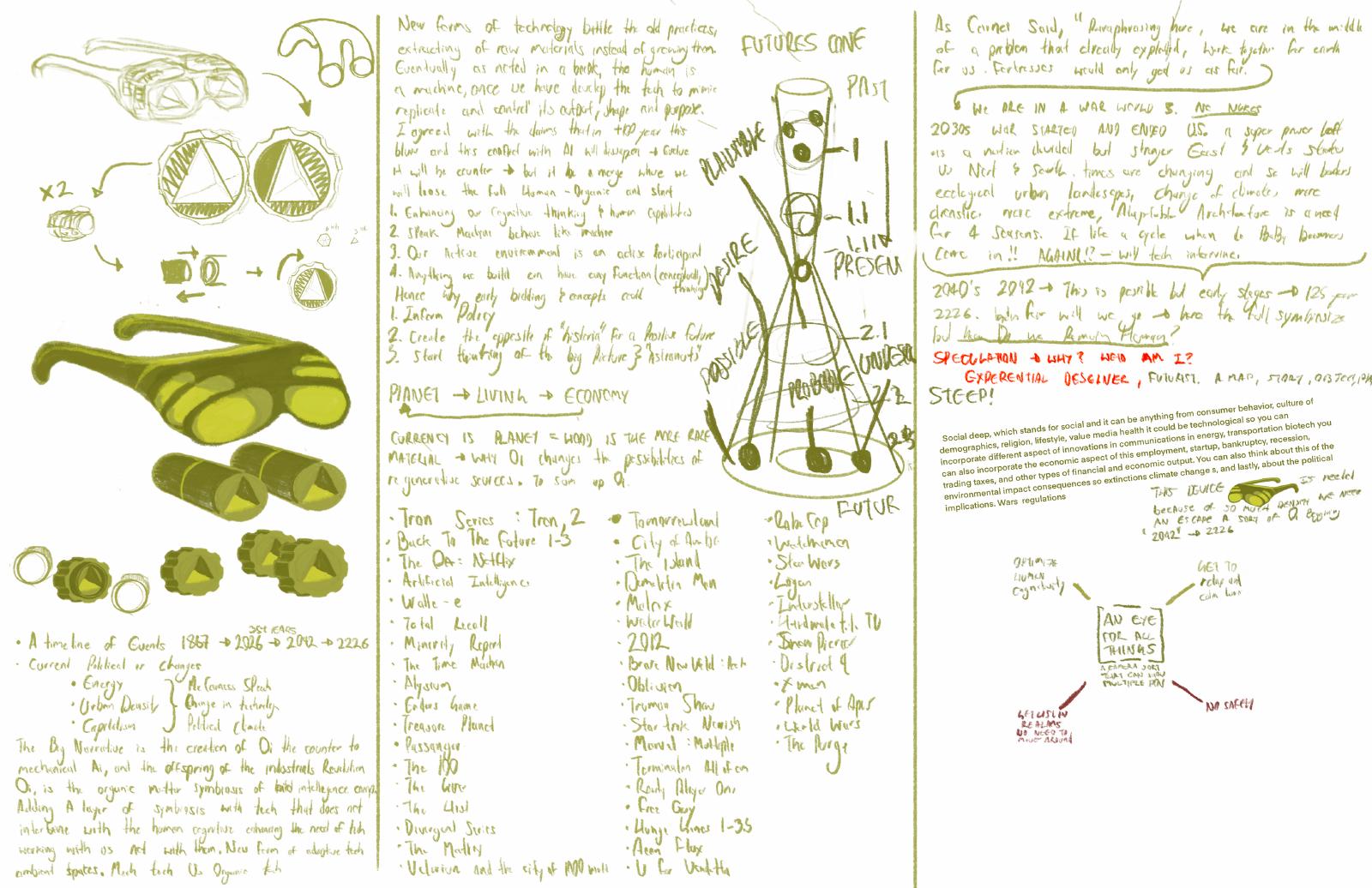
The first system map connects speculative tools, historical cycles and the city scale.
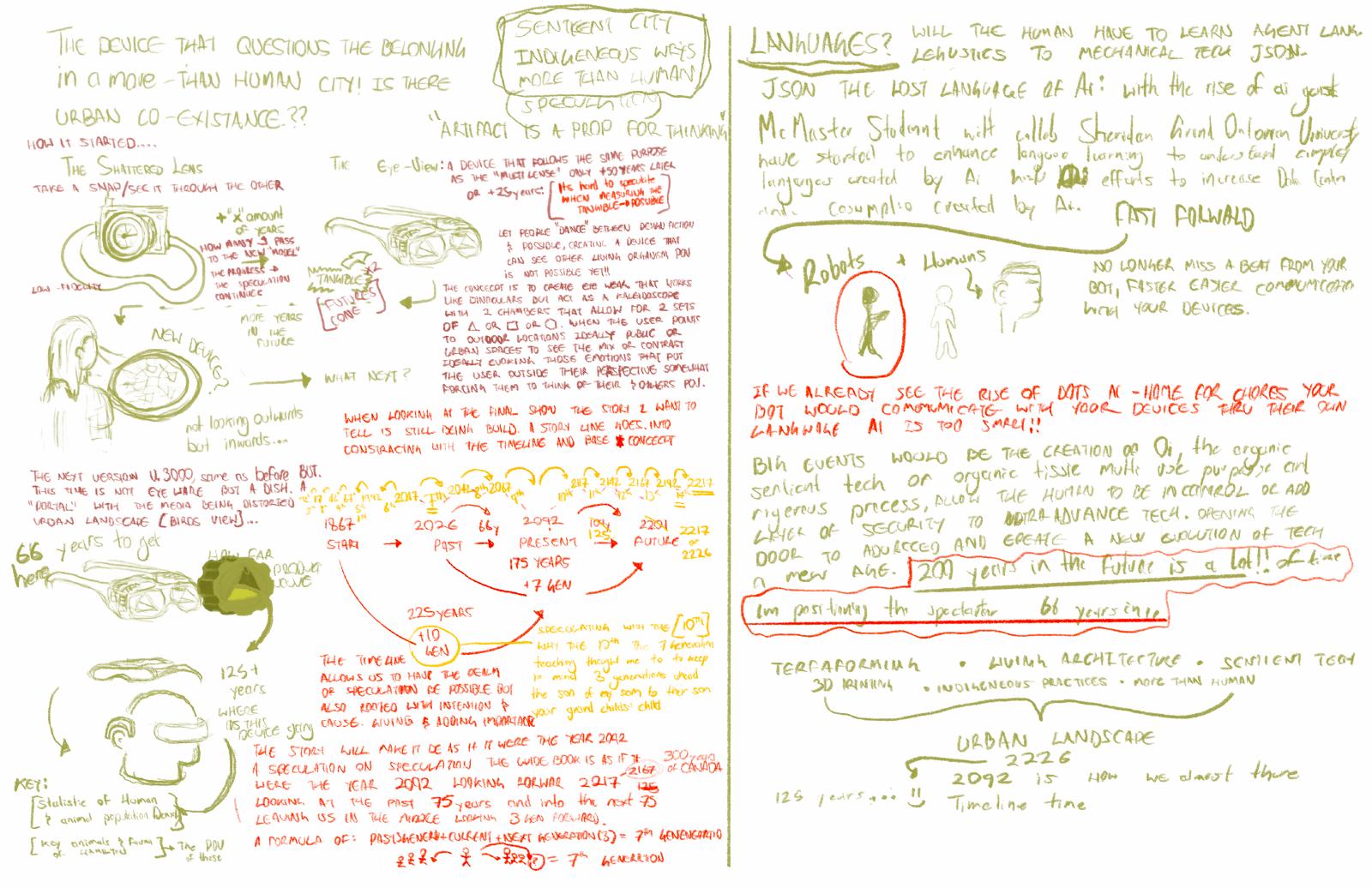
A second sheet narrows the timeline and develops the Multi-Lens as a challenge to a single point of view.
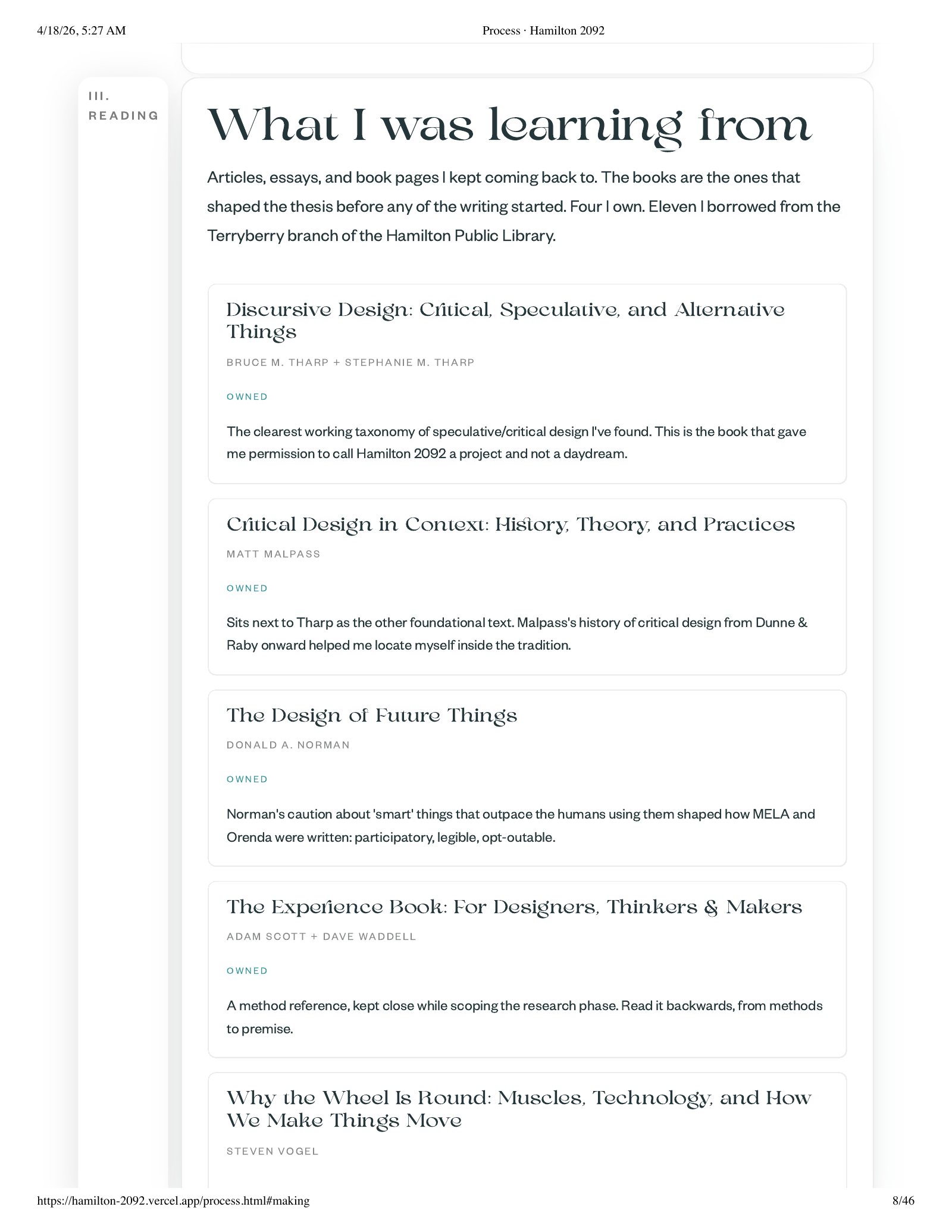
Books that changed the brief
These were not decorative references. Each changed what the city, its interfaces or its technologies were allowed to claim.
The complete archive also records The Experience Book, Why the Wheel Is Round, Wish I Were Here, Best Places to Bird in Ontario, Biohack Your Brain, Biofabrication, The Electric Vehicle Revolution, Simply Emerging Technology and The Wonderful Future That Never Was, with notes on how each informed the work.
02 / Foresight methods
Working sheets separated signals from assumptions, mapped consequences beyond the first order and positioned the proposal across probable, plausible and possible futures. They functioned like an exported workshop board: a trace of how the argument changed, not just a polished outcome.
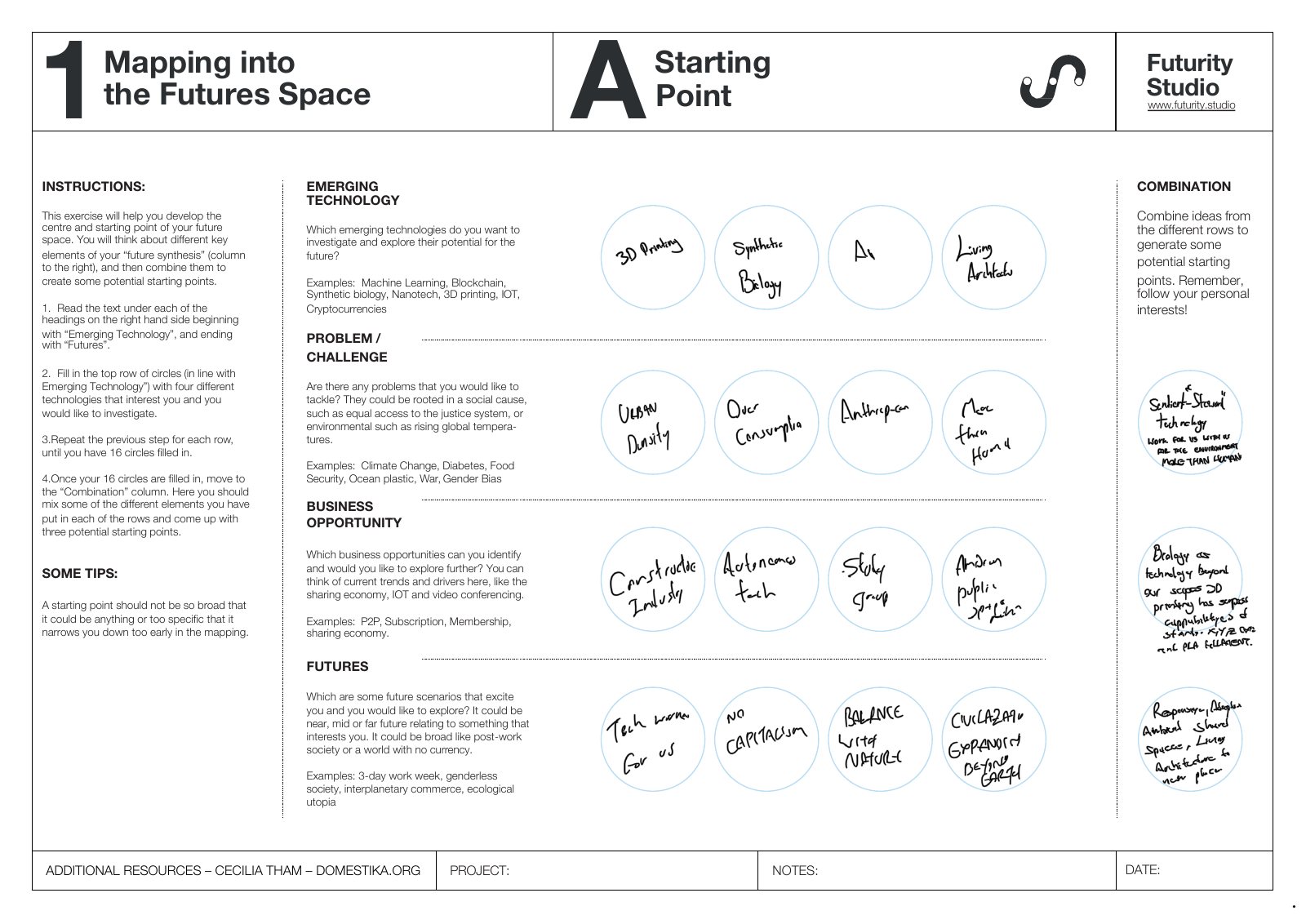
Signals and drivers established the starting conditions.
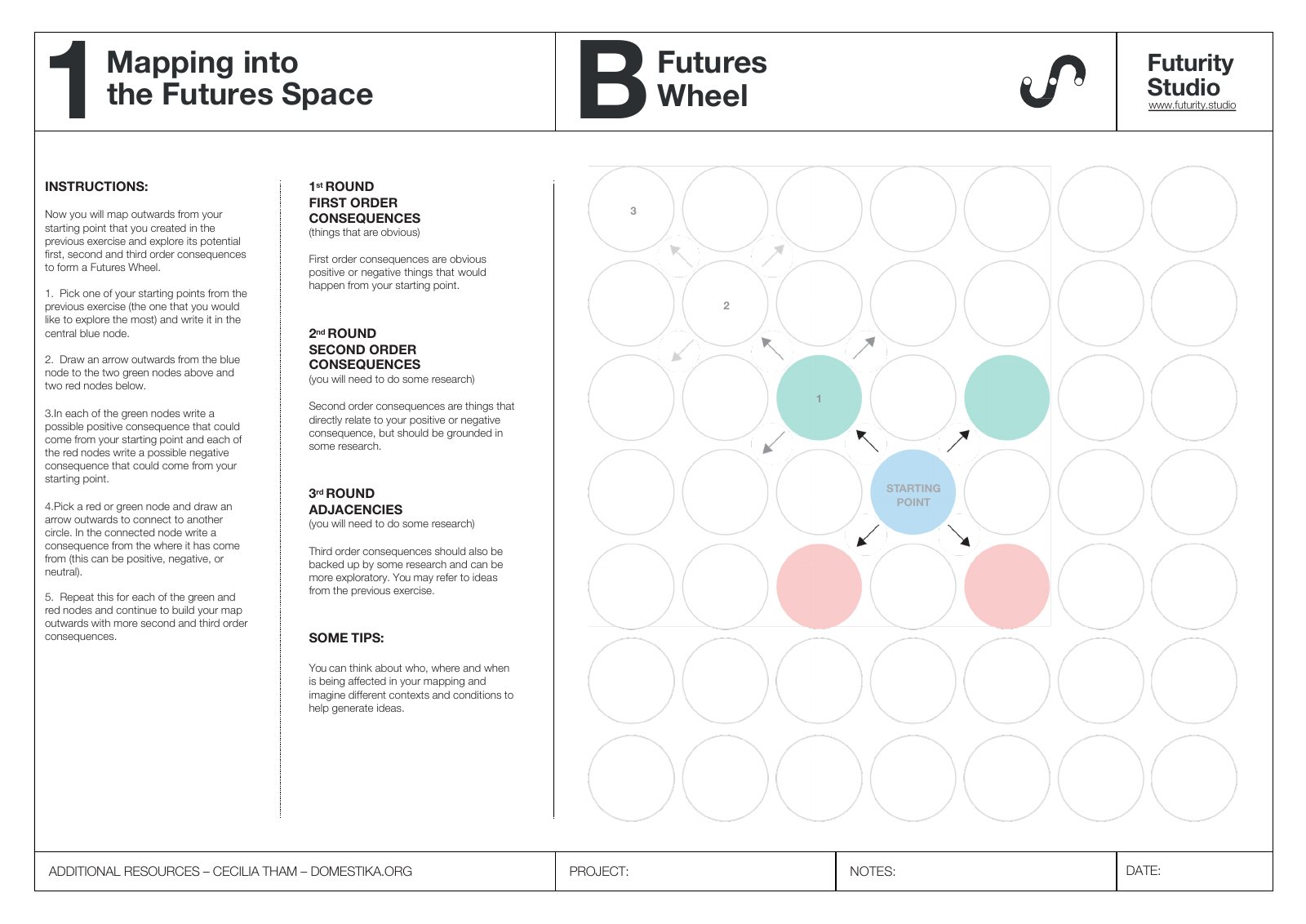
The Futures Wheel exposed social and ecological consequences beyond the first move.
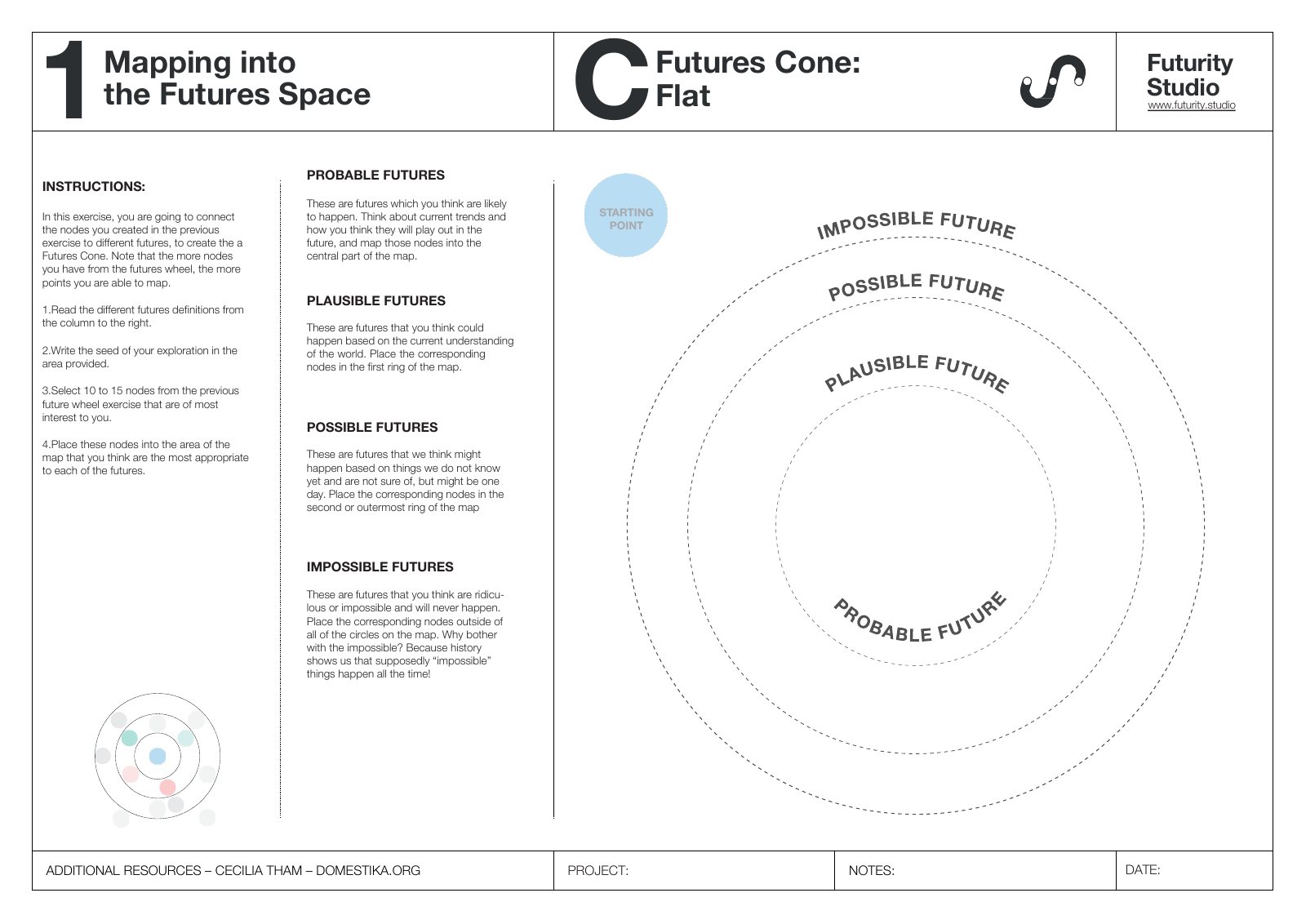
The cone kept the preferred future inside a discussable range of plausibility.
Archive note. The working evidence is preserved as exported worksheets, process-book pages and website records. A direct Miro share URL was not found in the indexed local archive, so the portfolio does not publish or imply one.
03 / Process archive
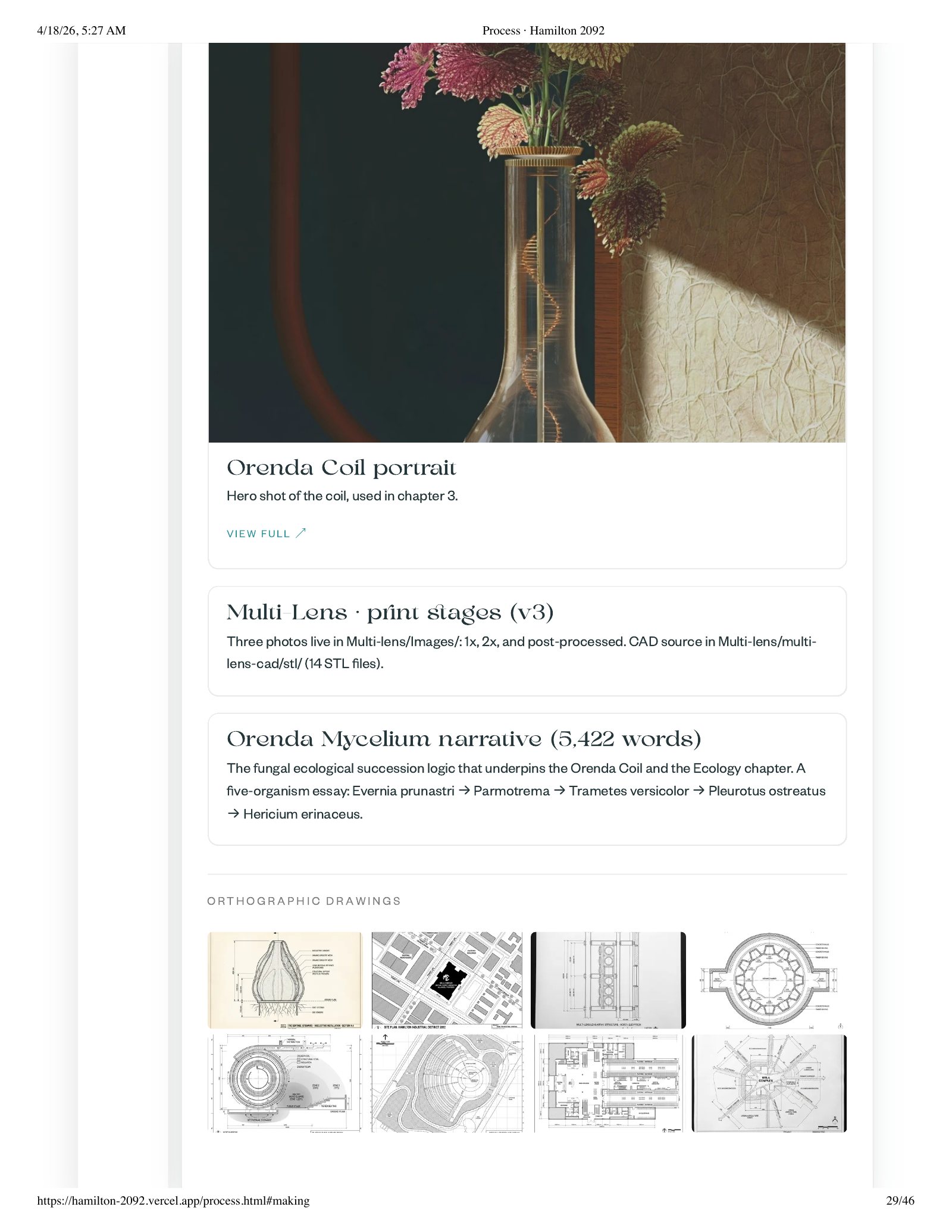
The 46-page process book records reading, field walks, image collecting, model-making, prompt development, editorial systems and interactive labs. Selected pages are surfaced here so a reviewer can understand the work without opening a PDF.
Prompt direction edited image
The archive contains a 15-scene presentation prompt set and a 56-image figure system. Prompts named the scene, purpose, spatial relationship, material language and intended use; outputs were then selected, corrected and placed inside the editorial system.
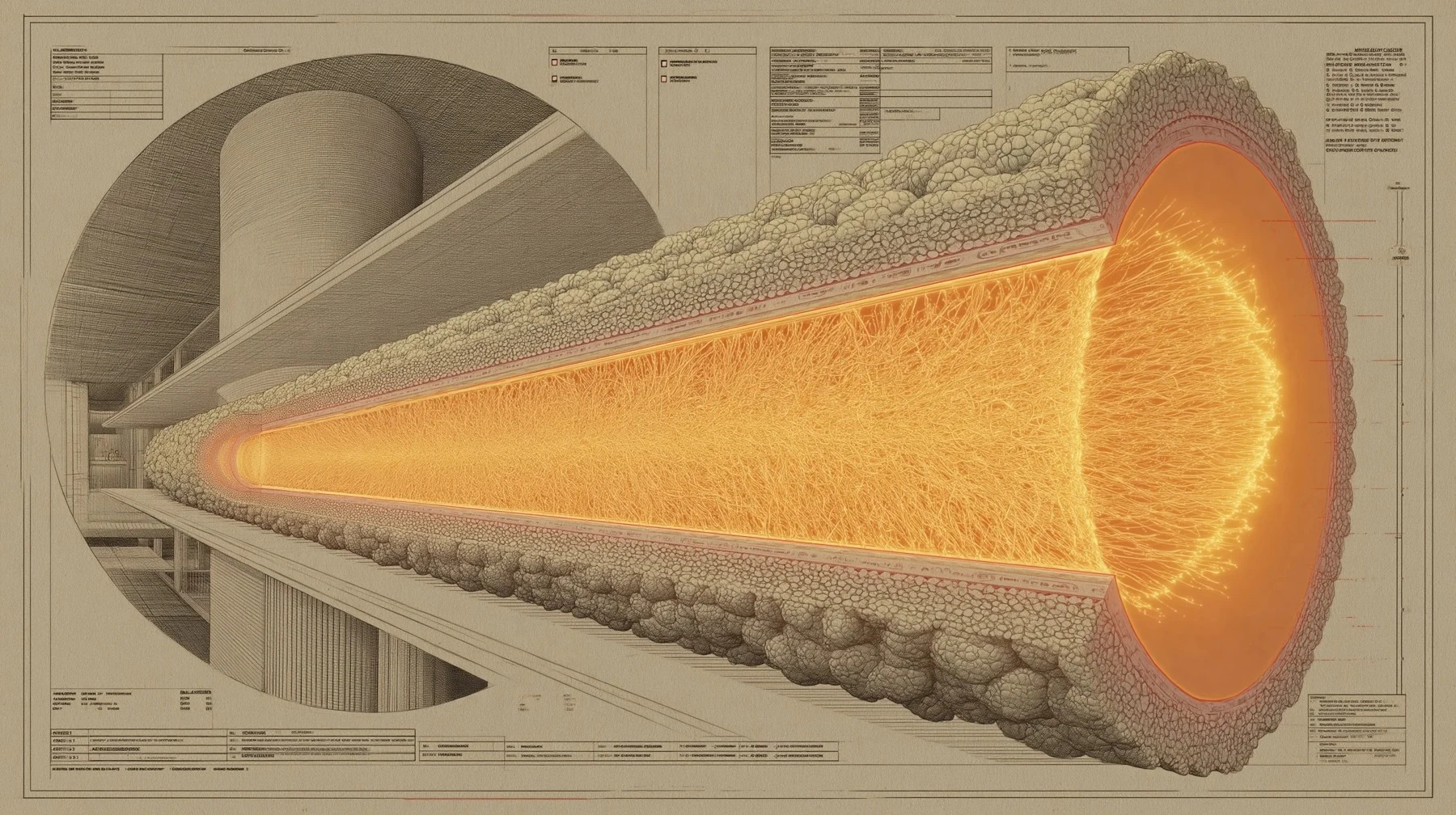
City overview. A bird’s-eye brief specified the escarpment, harbour, remediated industrial zones and rail spine before the image entered the guidebook.
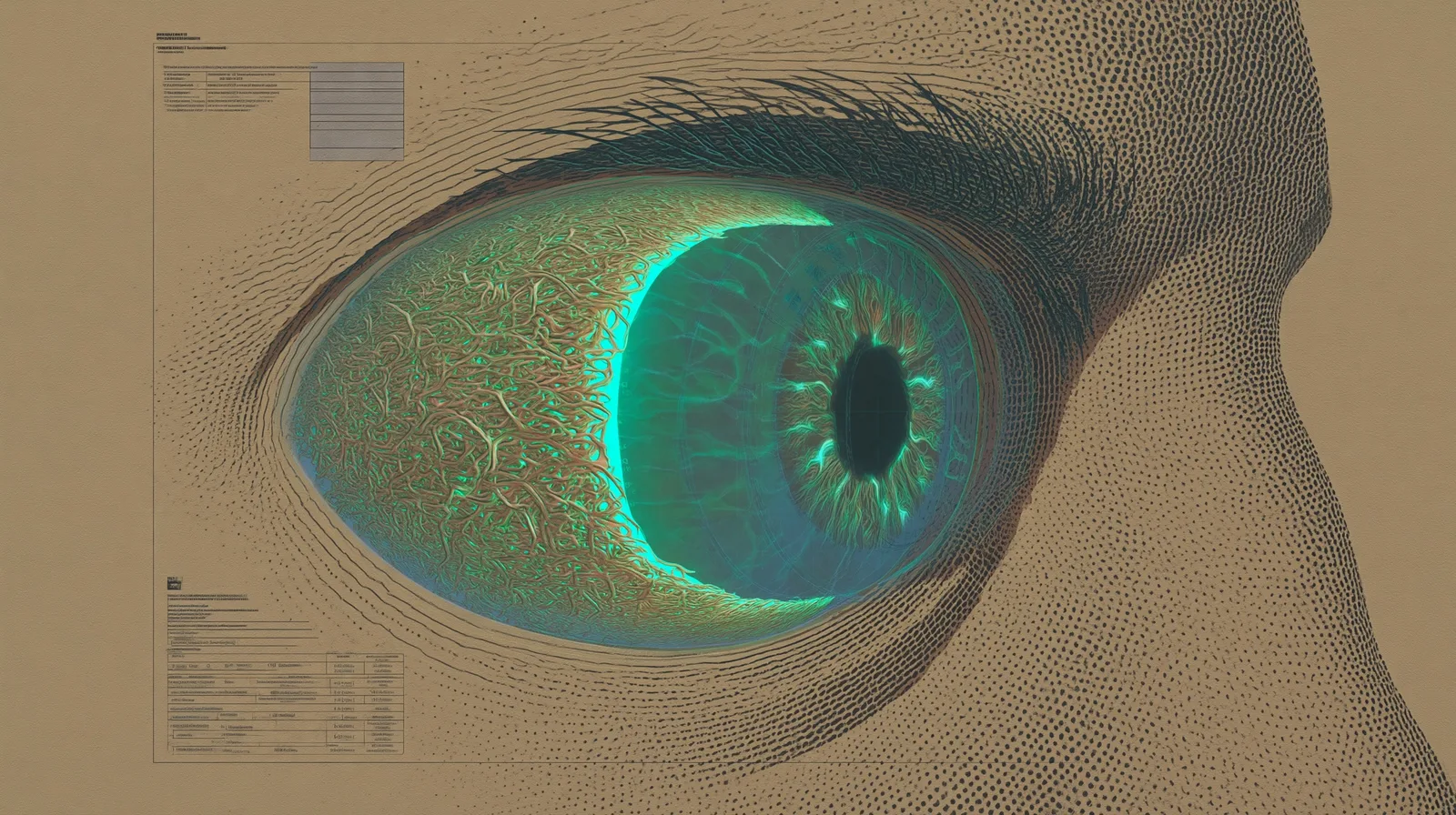
Multi-Lens. The prompt described a wearable perceptual interface with layered optics and bio-conductive circuitry; later technical drawings separated concept from build claim.
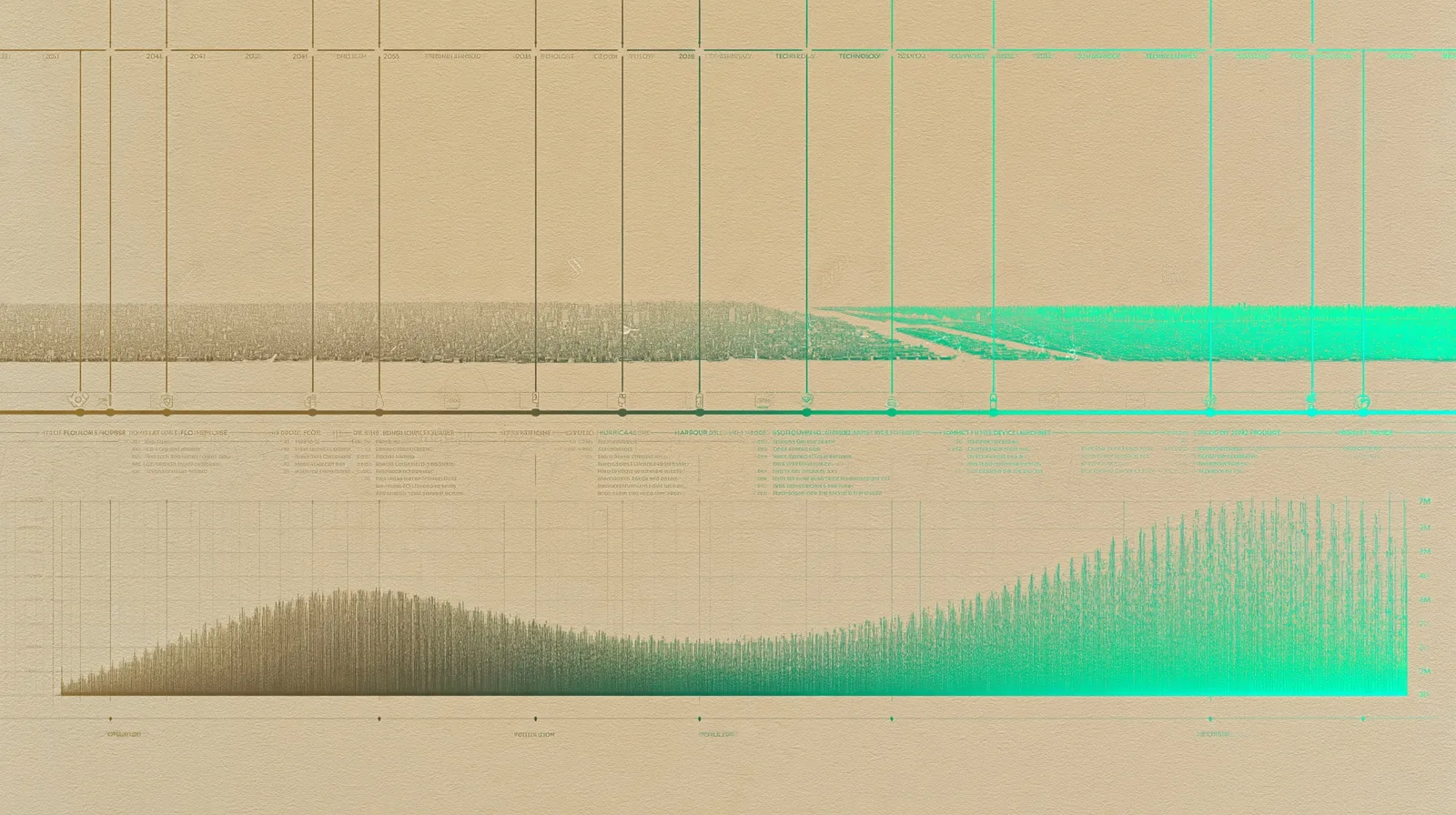
Timeline. The scene brief organized climate events, social shifts and technology milestones into an editorial time system instead of a single futuristic image.
04 / Guidebook
The guidebook is the project’s clearest entry point. Maps, chapters, characters and visitor instructions translate a large speculative system into moments a reader can understand without first learning the entire thesis.
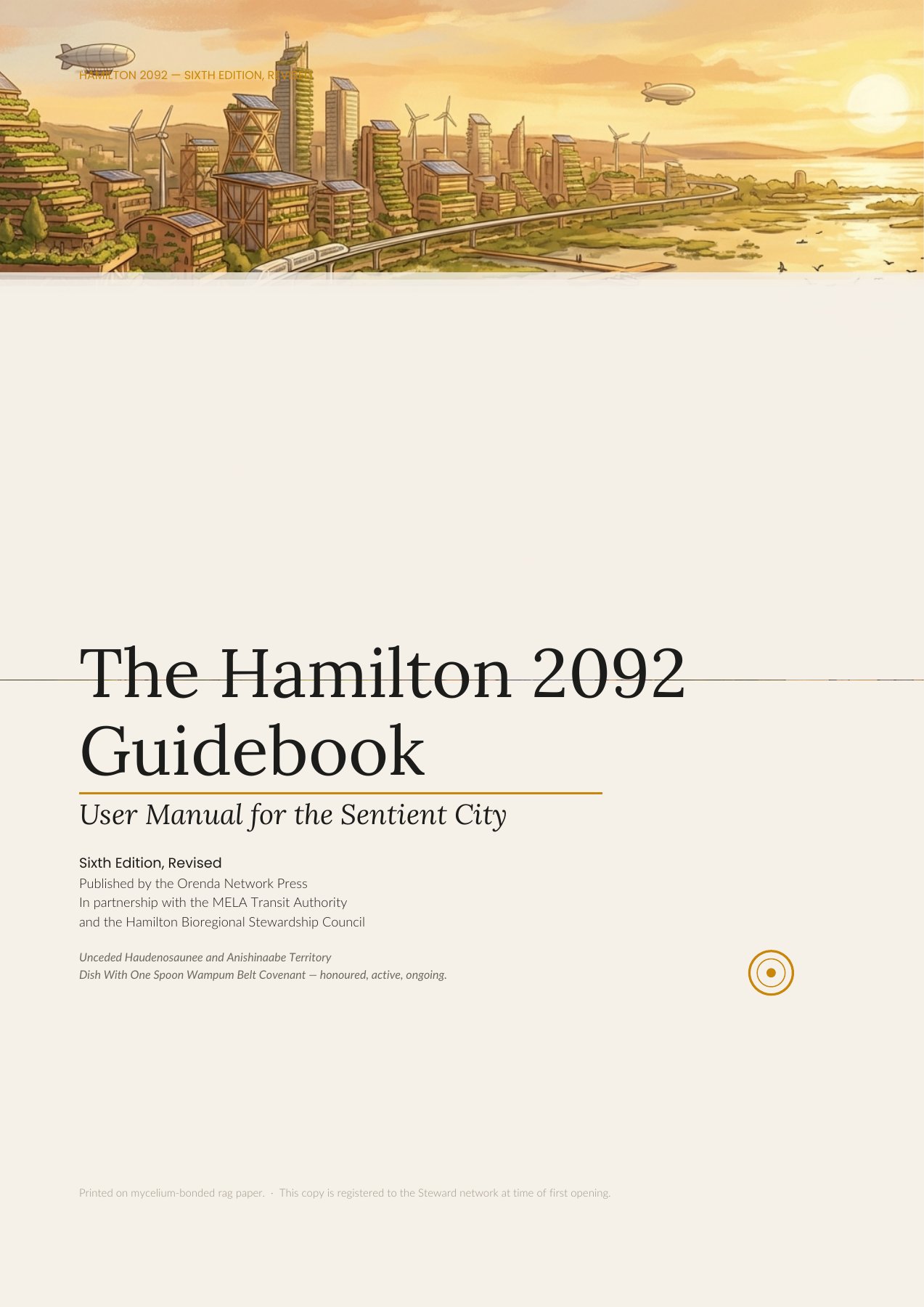
A restrained cover establishes the civic-document voice.
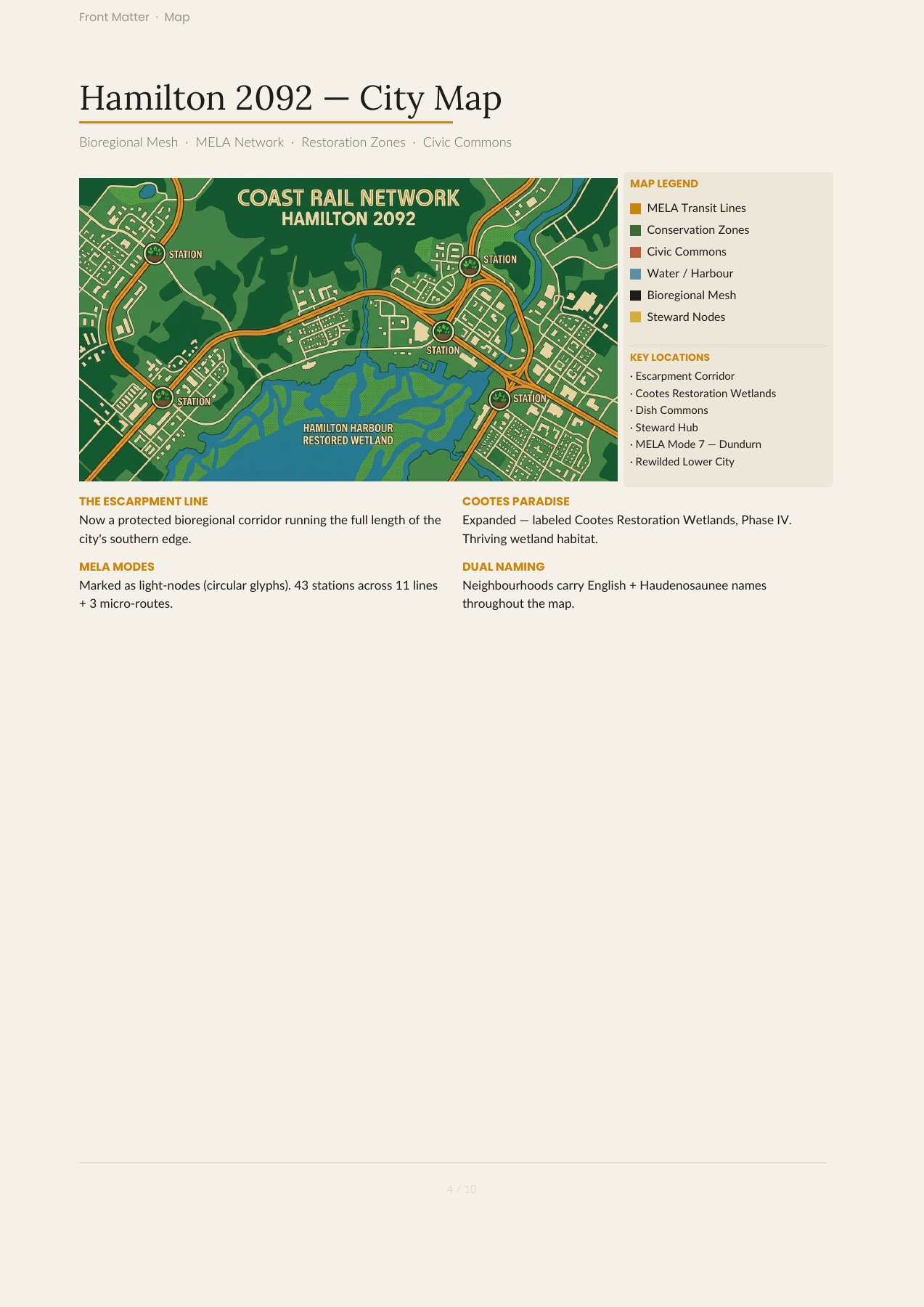
The map connects restoration zones, commons and mobility.
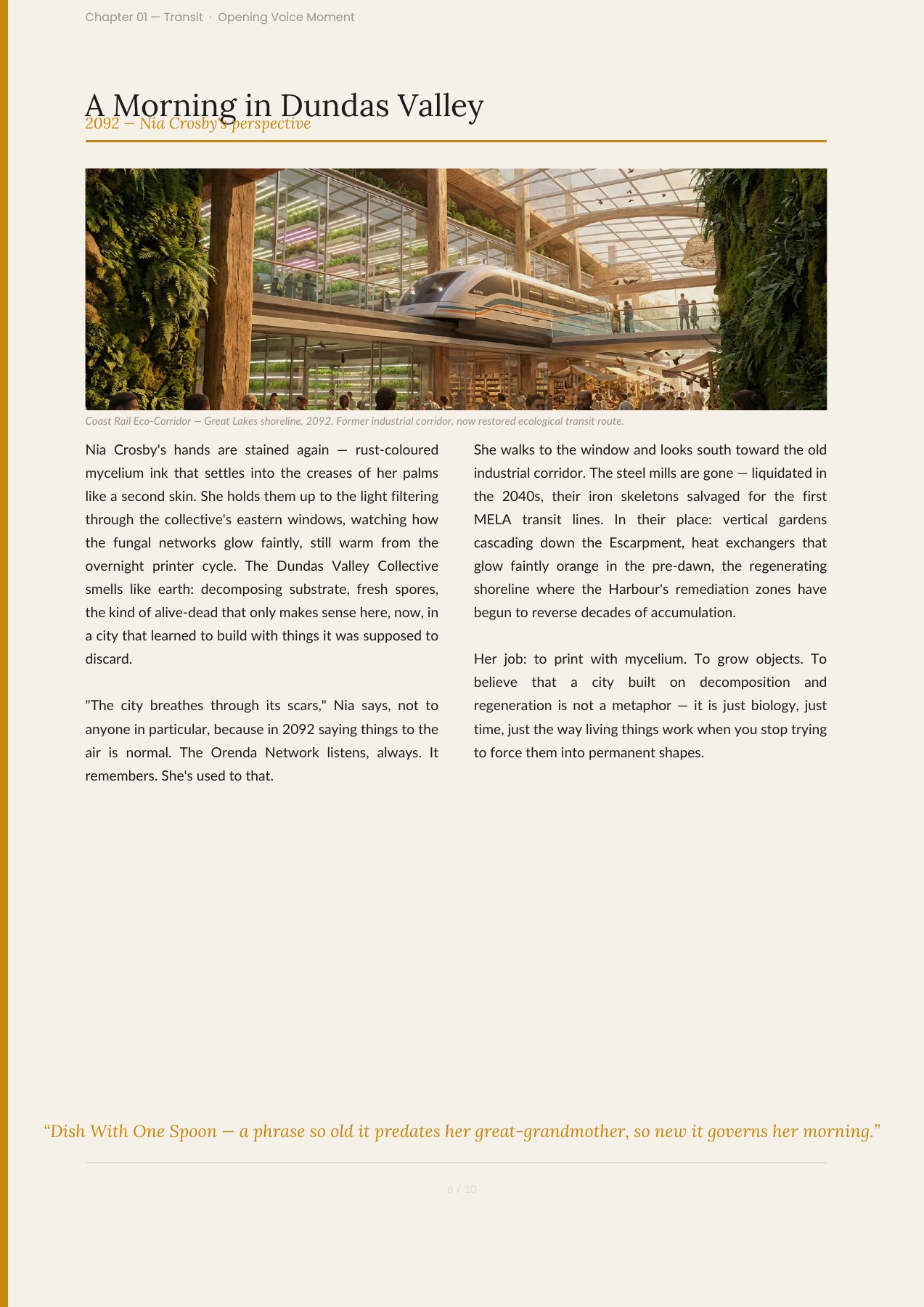
A resident’s morning makes the world social rather than abstract.
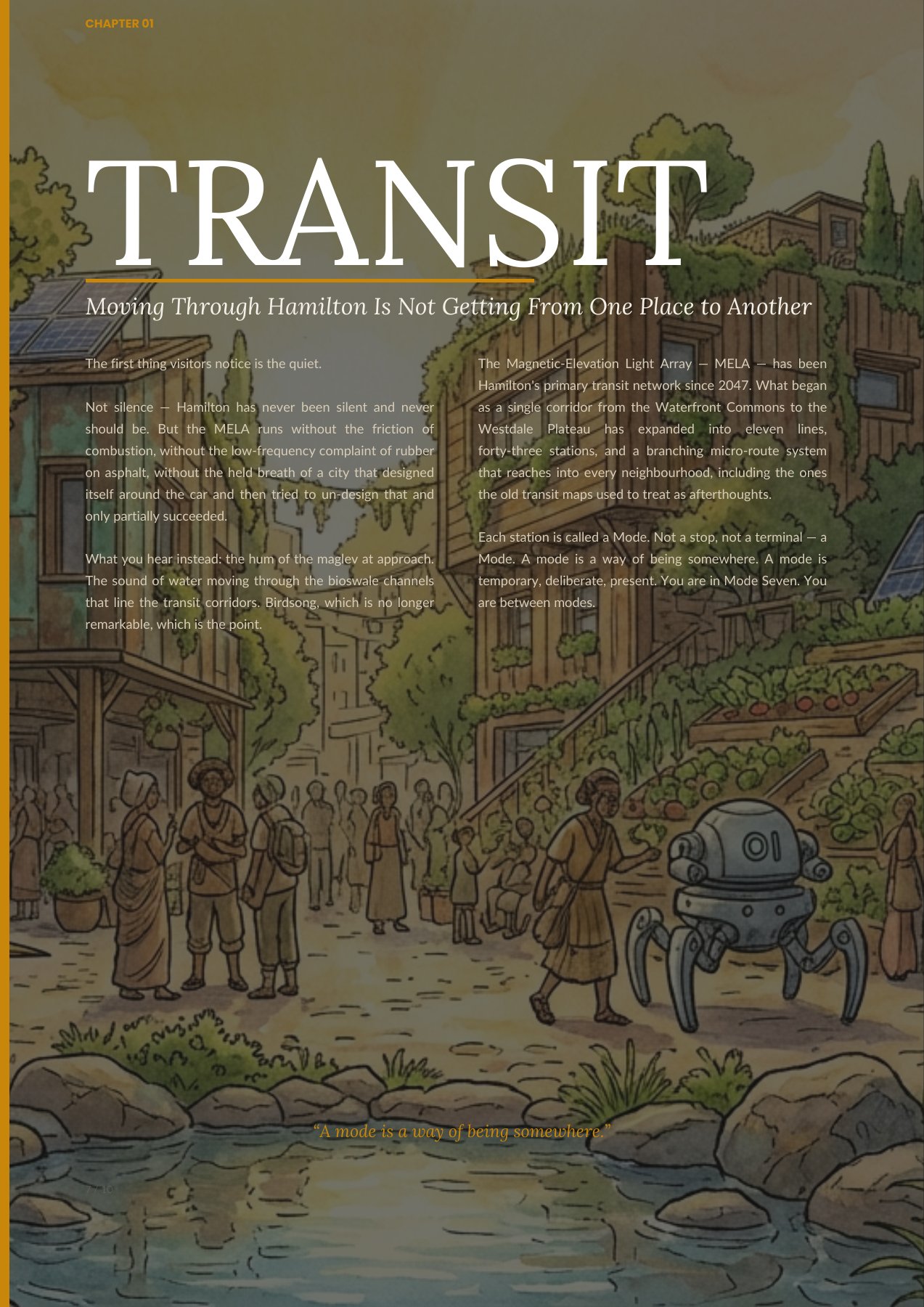
The transit chapter shifts from system to lived experience.
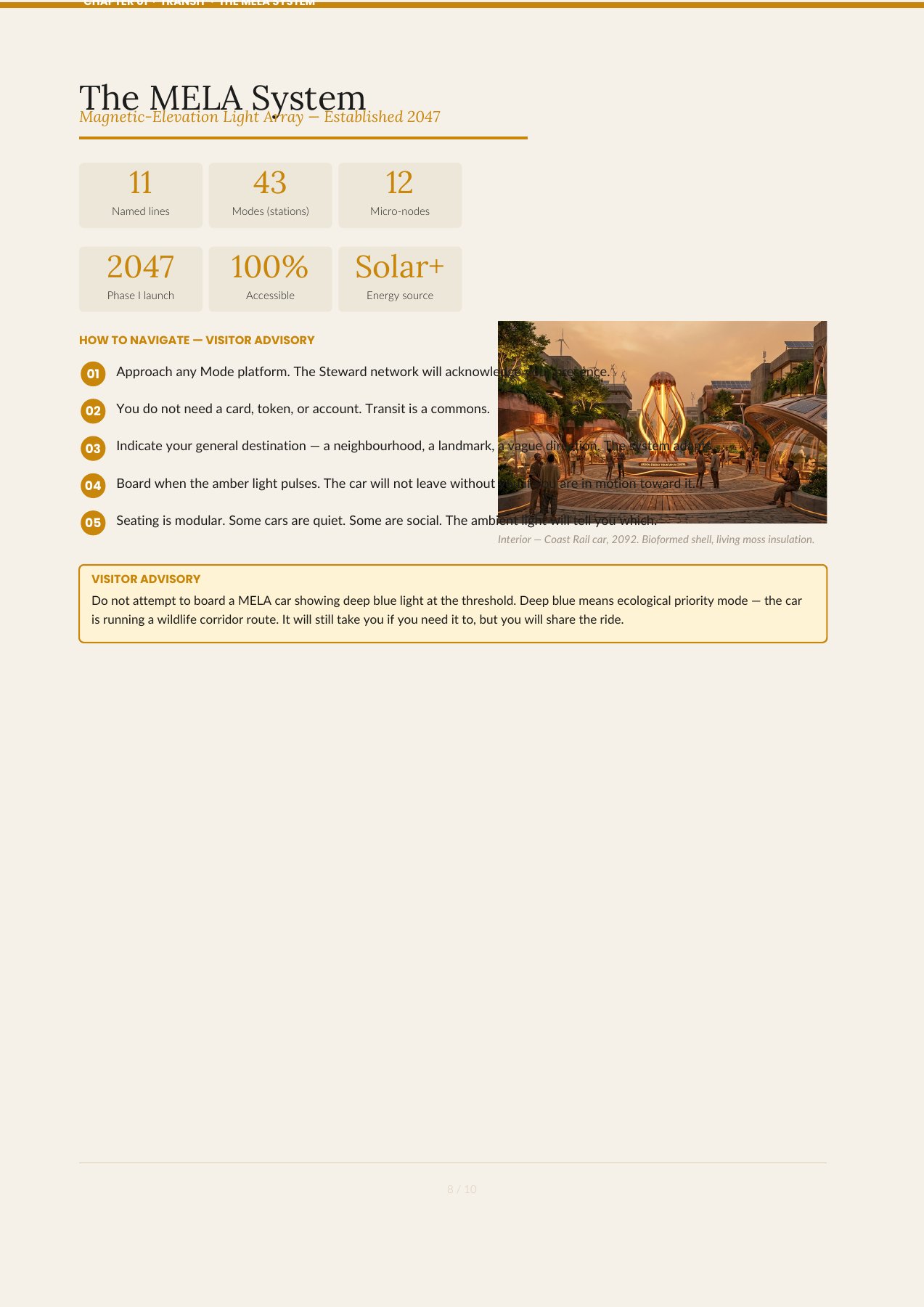
A fictional service guide gives the MELA system rules and rhythm.
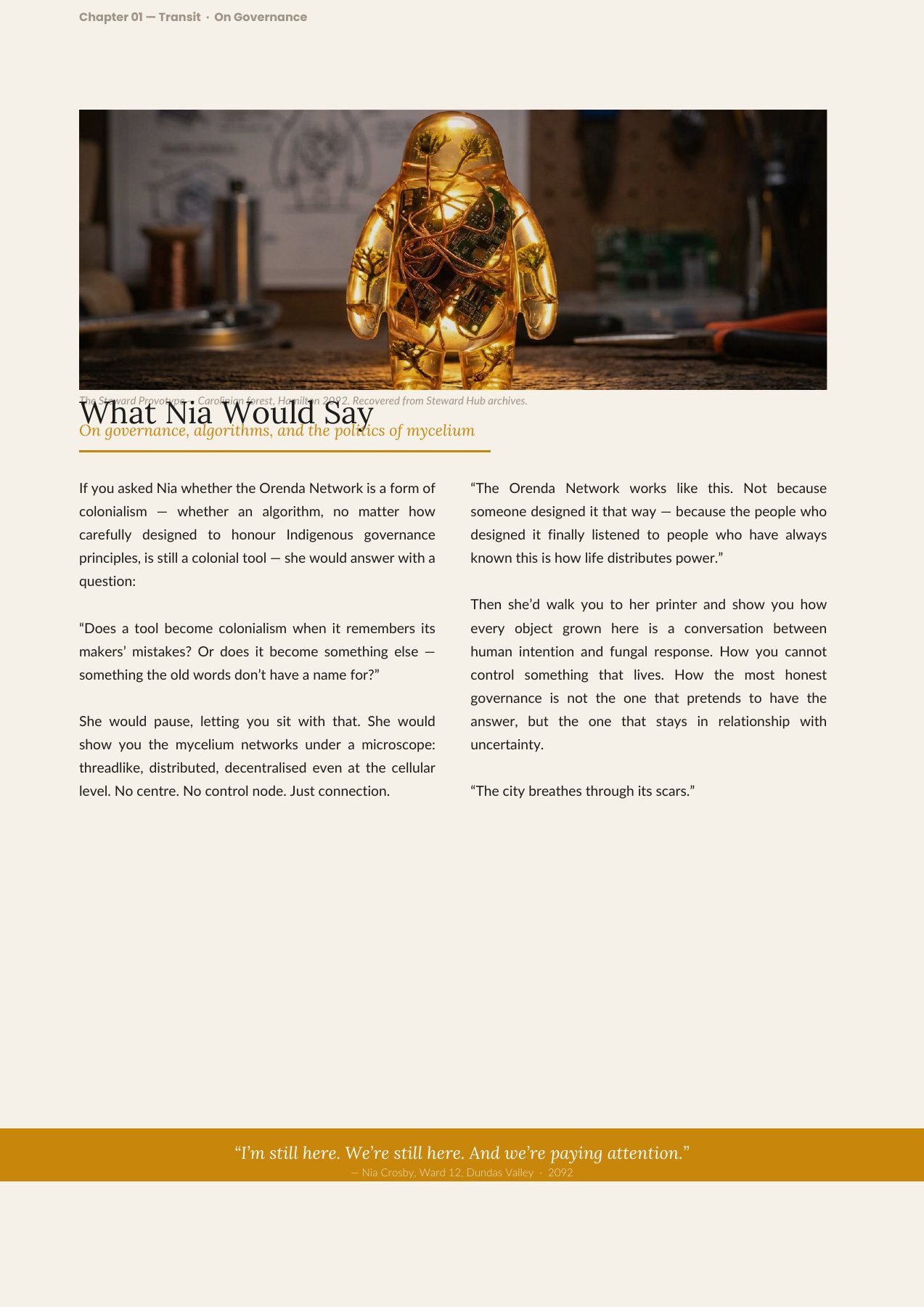
A character story links the publication back to the Orenda Coil.
05 / Three speculative artifacts
Each artifact explores a different relationship between people, technology and place. The physical studies prove form, assembly and visual language; their future functions remain speculative.
Artifact 01 · built model + visualization
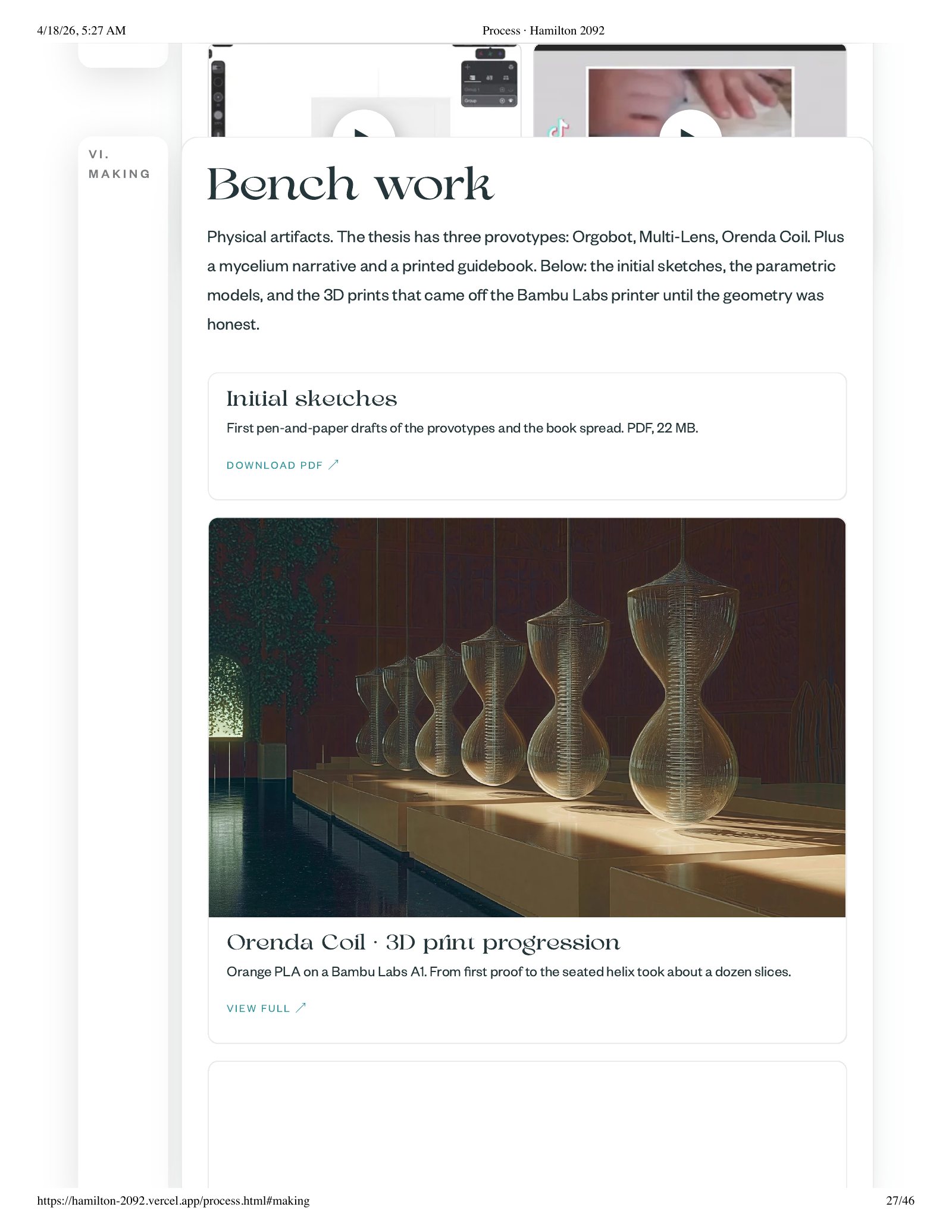
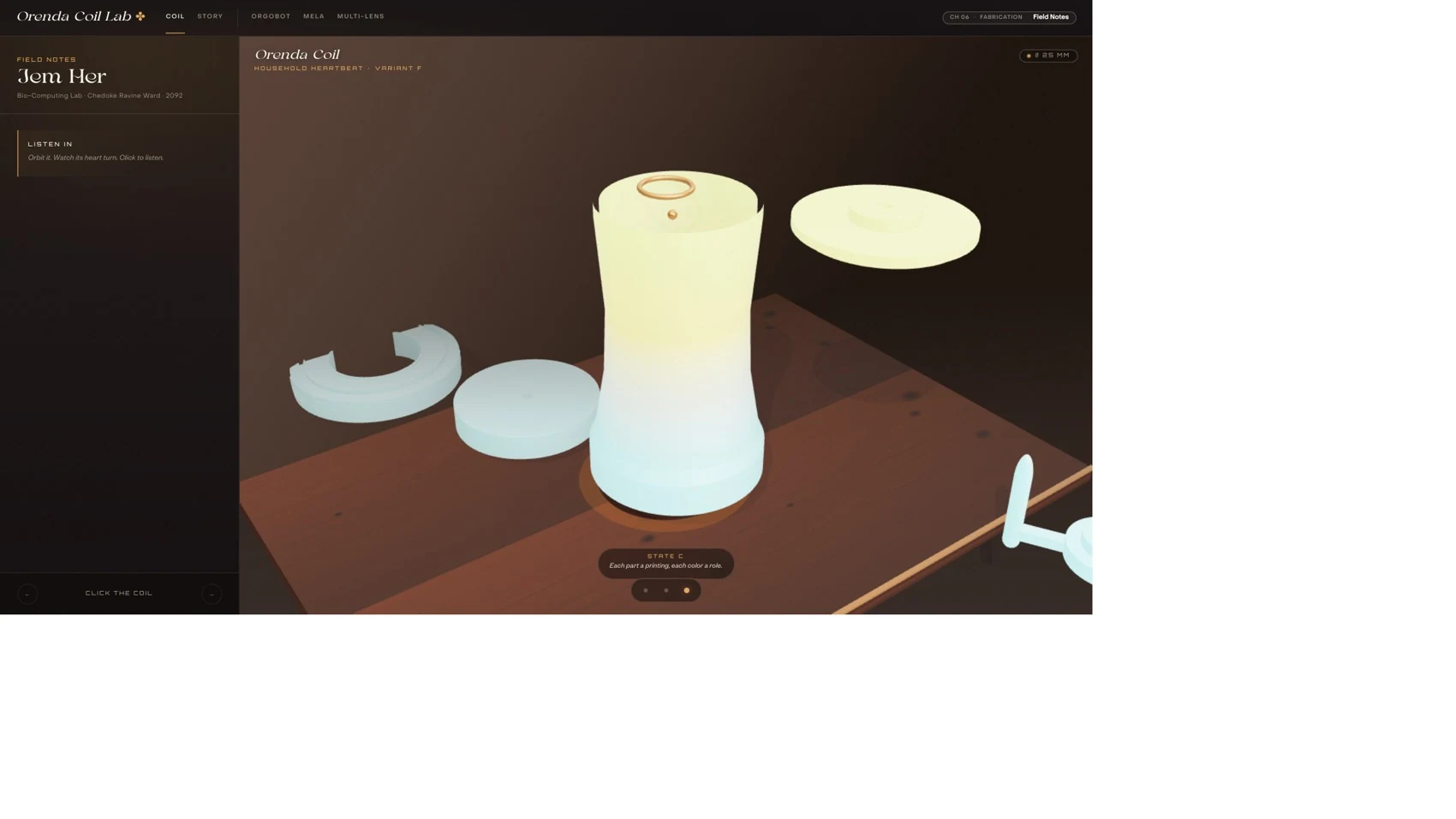
A light-bearing civic object imagined as part infrastructure, part gathering point. A fabricated illuminated model tests silhouette and assembly; the concept render and exploded view communicate its urban role and internal logic.
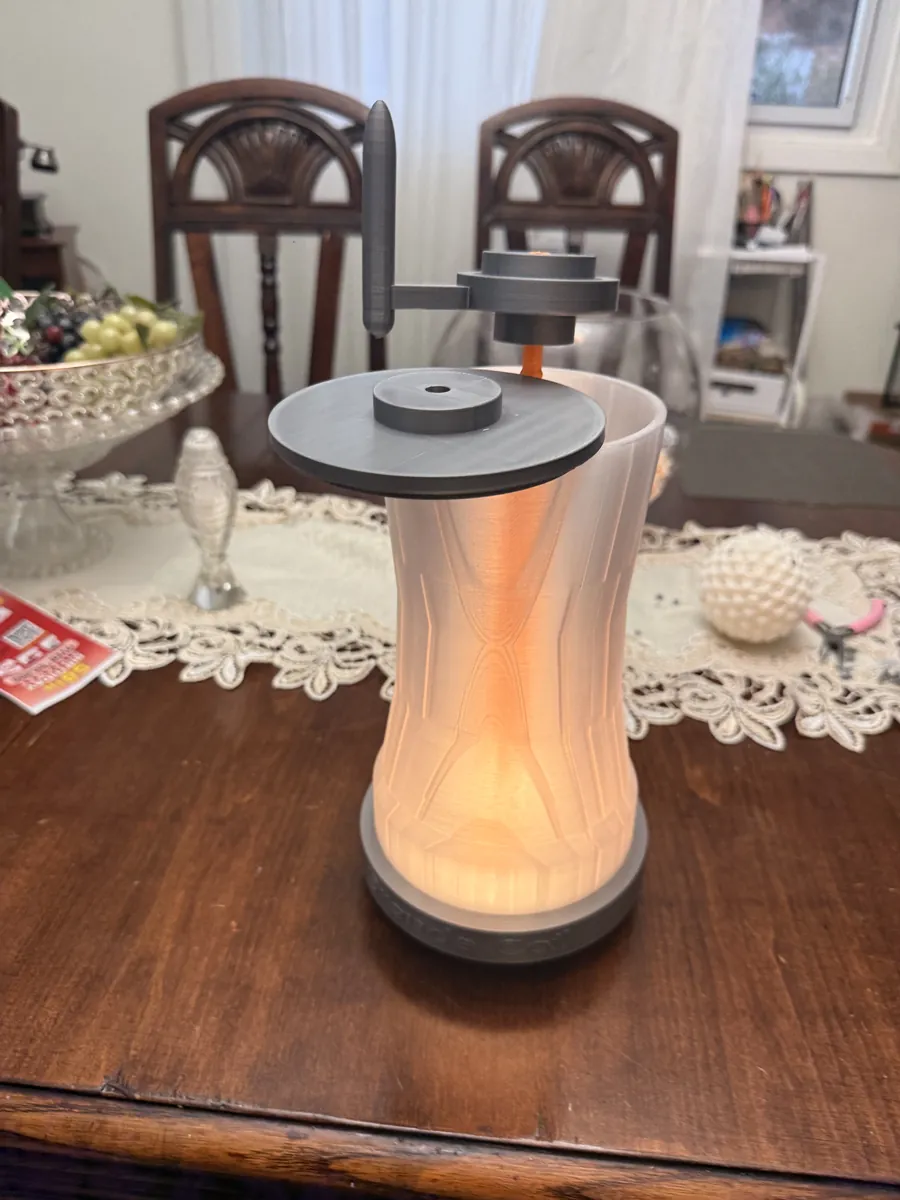
Artifact 02 · fabricated form studies
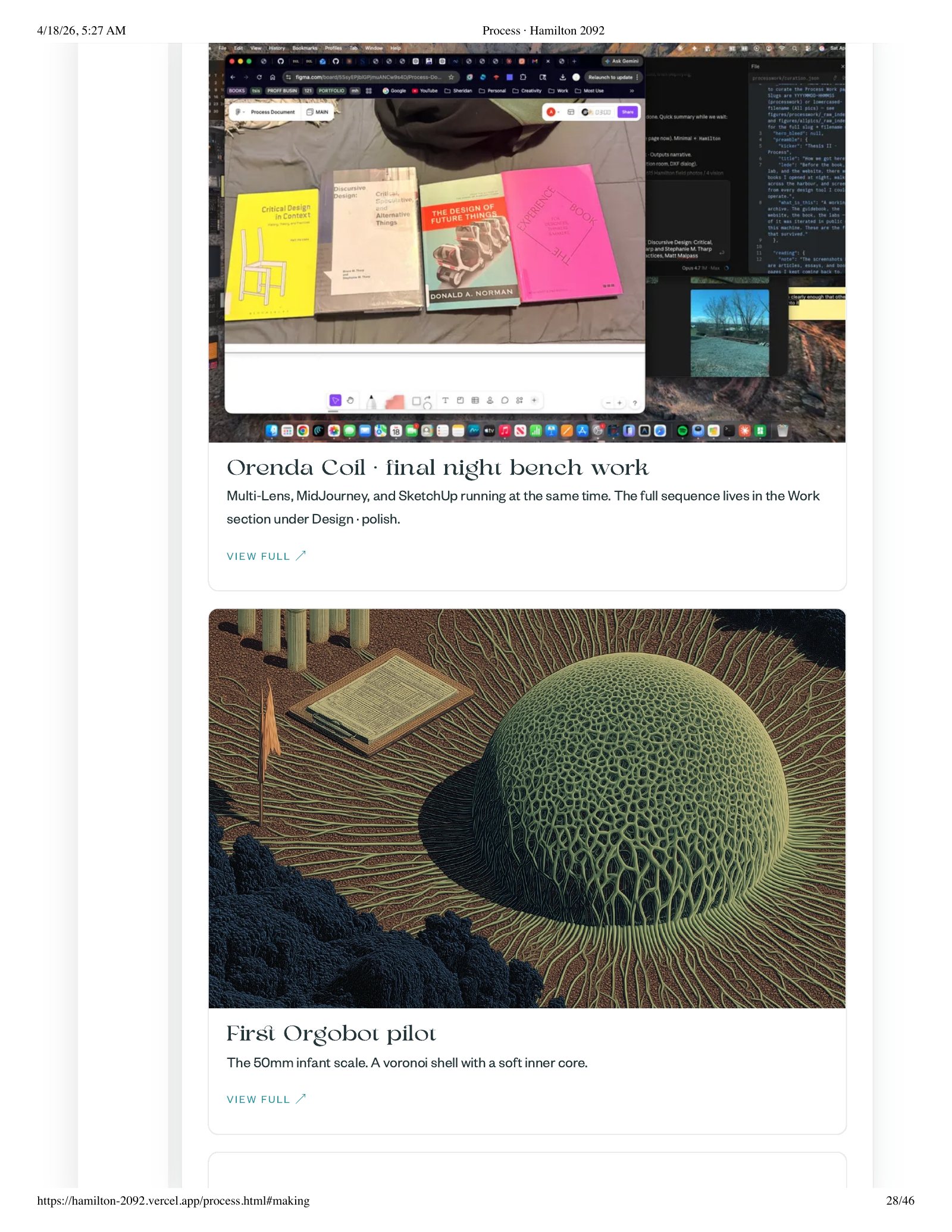
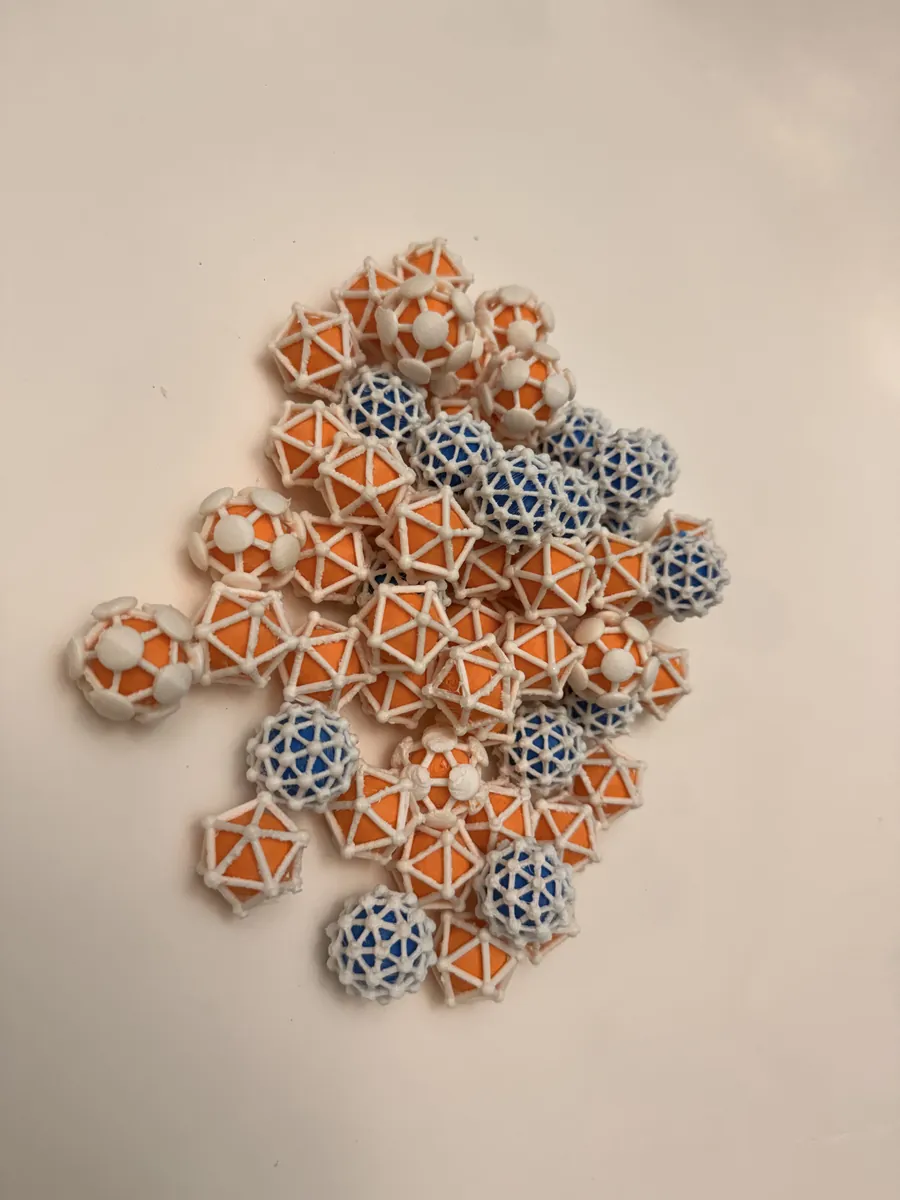
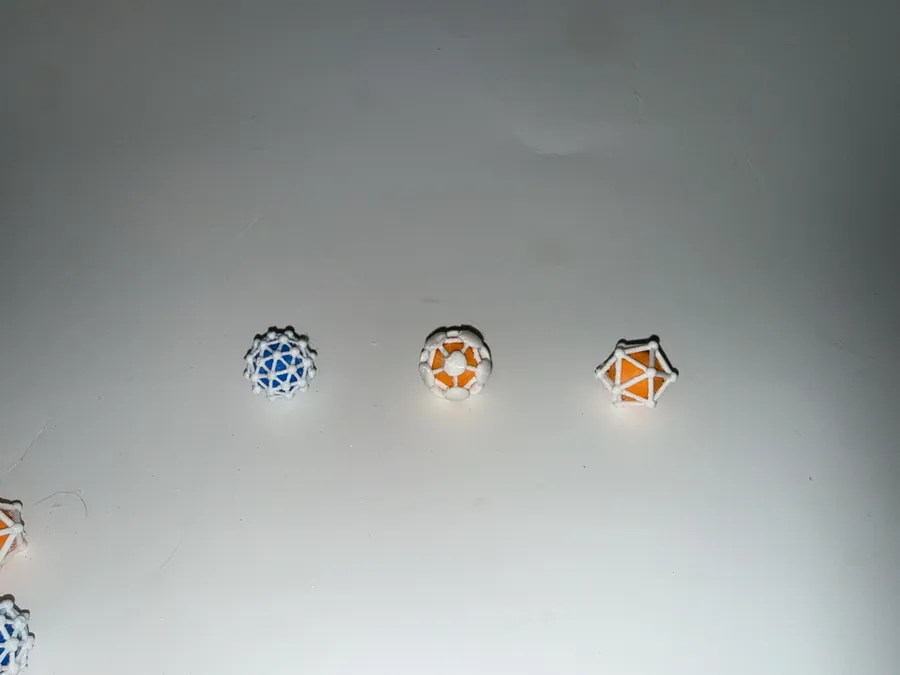
A family of small forms that turns a city-scale ecological idea into a modular, character-led system. These photographs document made studies; sensing or autonomous behaviour is not claimed.
Artifact 03 · technical concept development
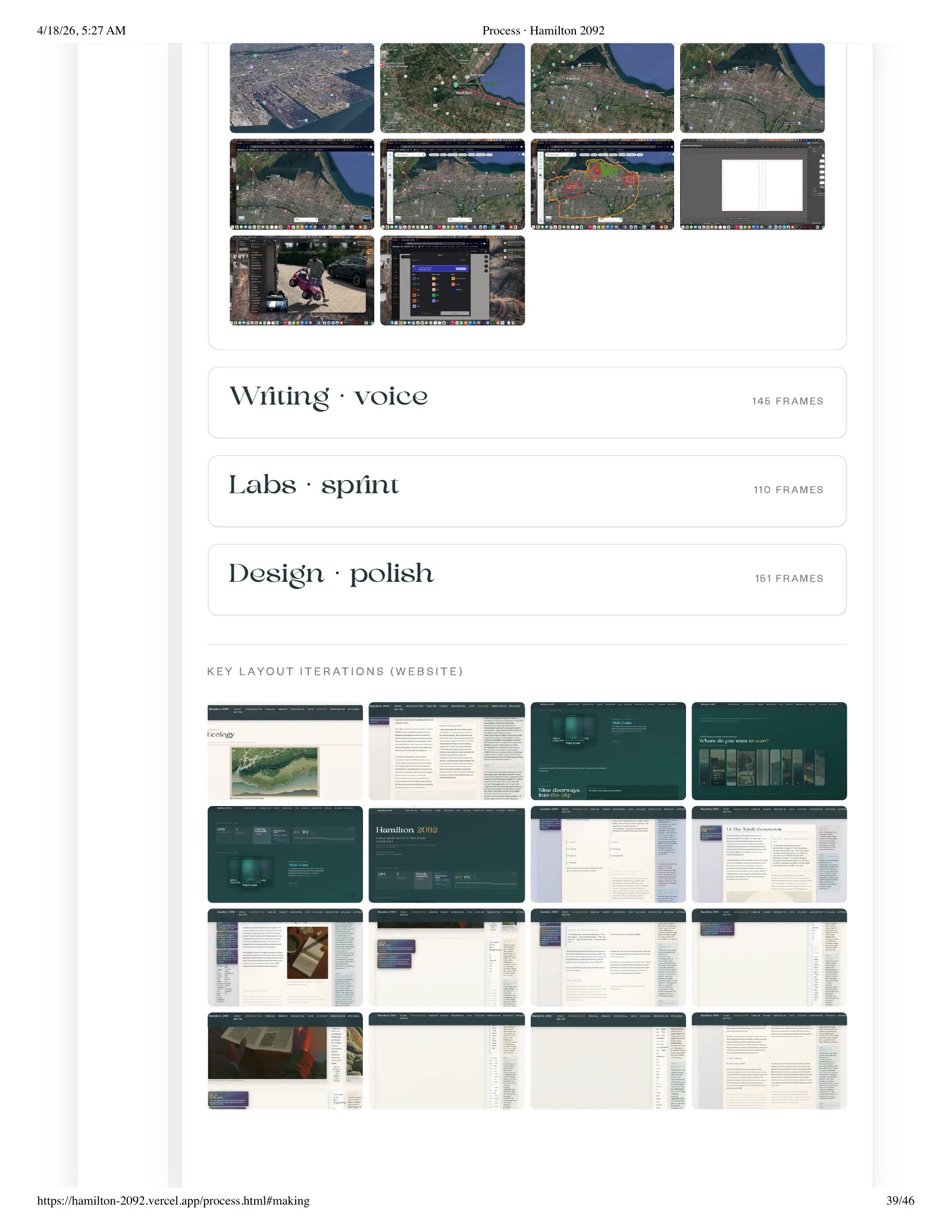
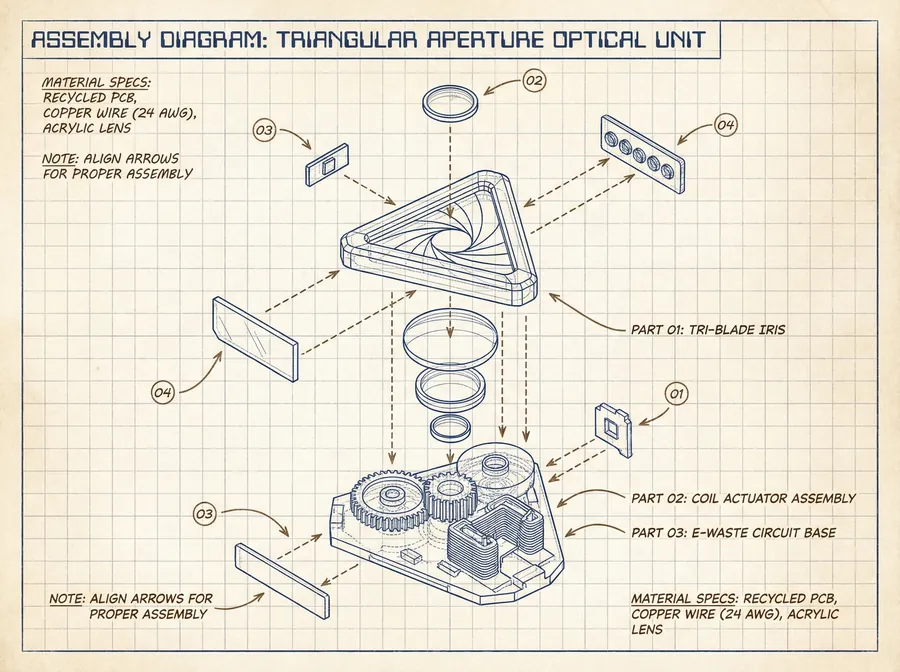
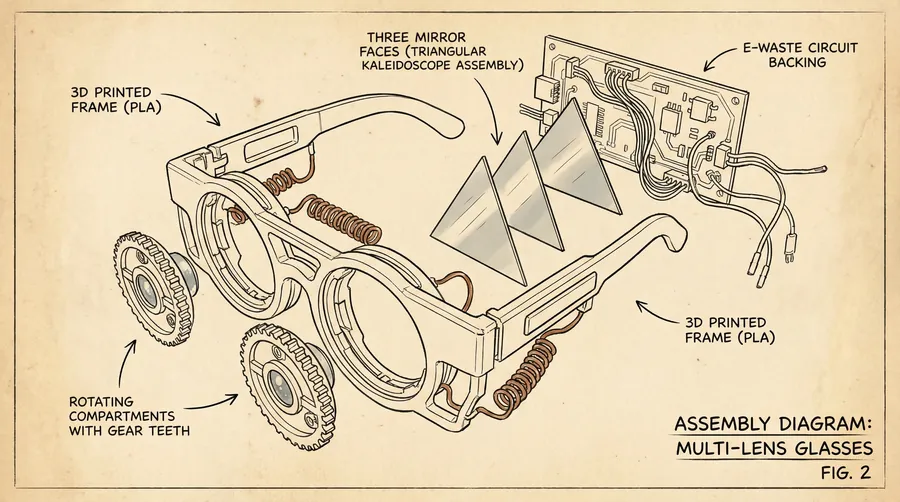
A wearable provotype about perception: how might one object make competing views visible at once? The assembly and exploded drawings develop the idea; they are concept illustrations, not evidence of a functioning optical product.
06 / Website & interactive labs
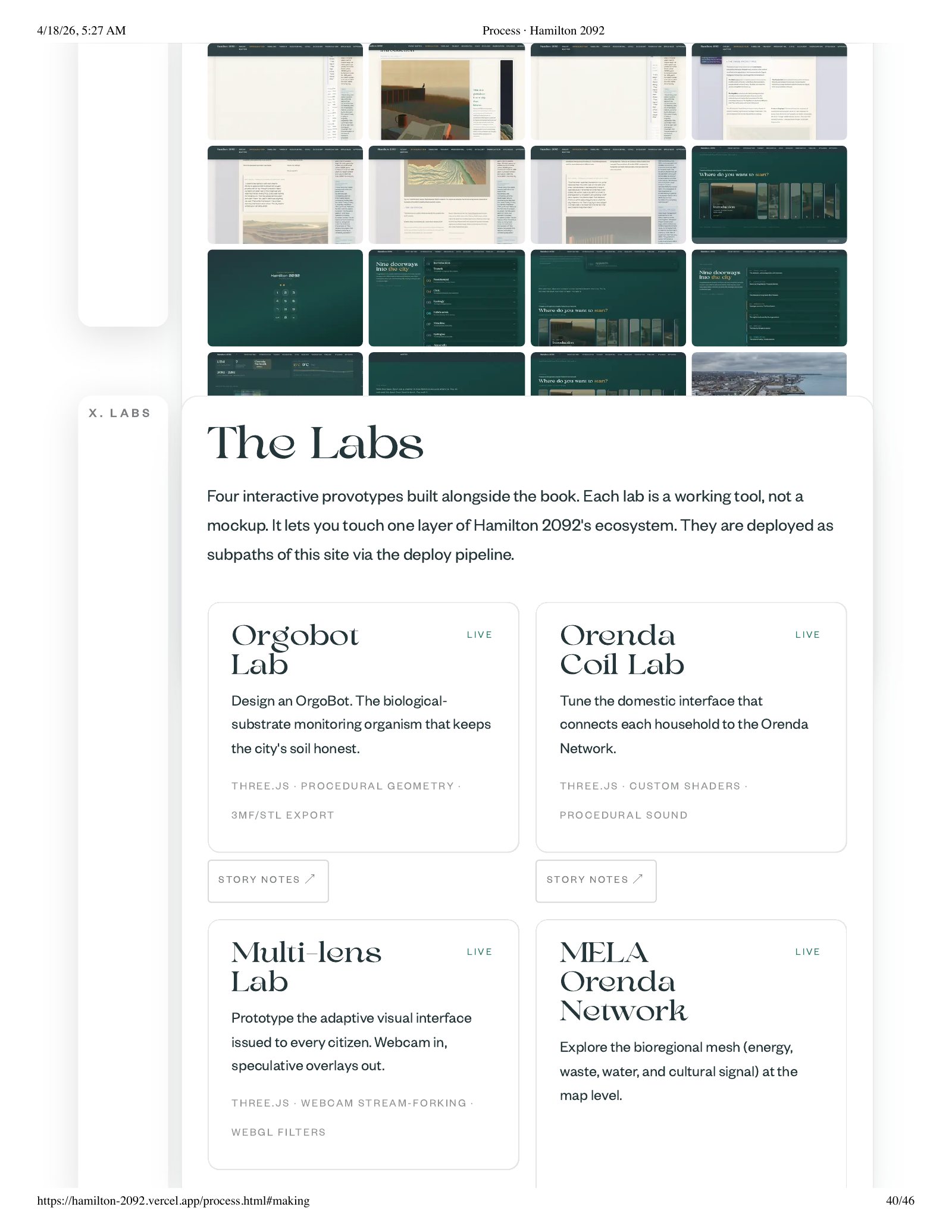
The delivered website carries the proposition, ten guidebook chapters, responsive editorial layouts, character-led stories, artifact labs and the full process archive. The screens here document the actual interface rather than a generic browser mockup.
Enter Hamilton 2092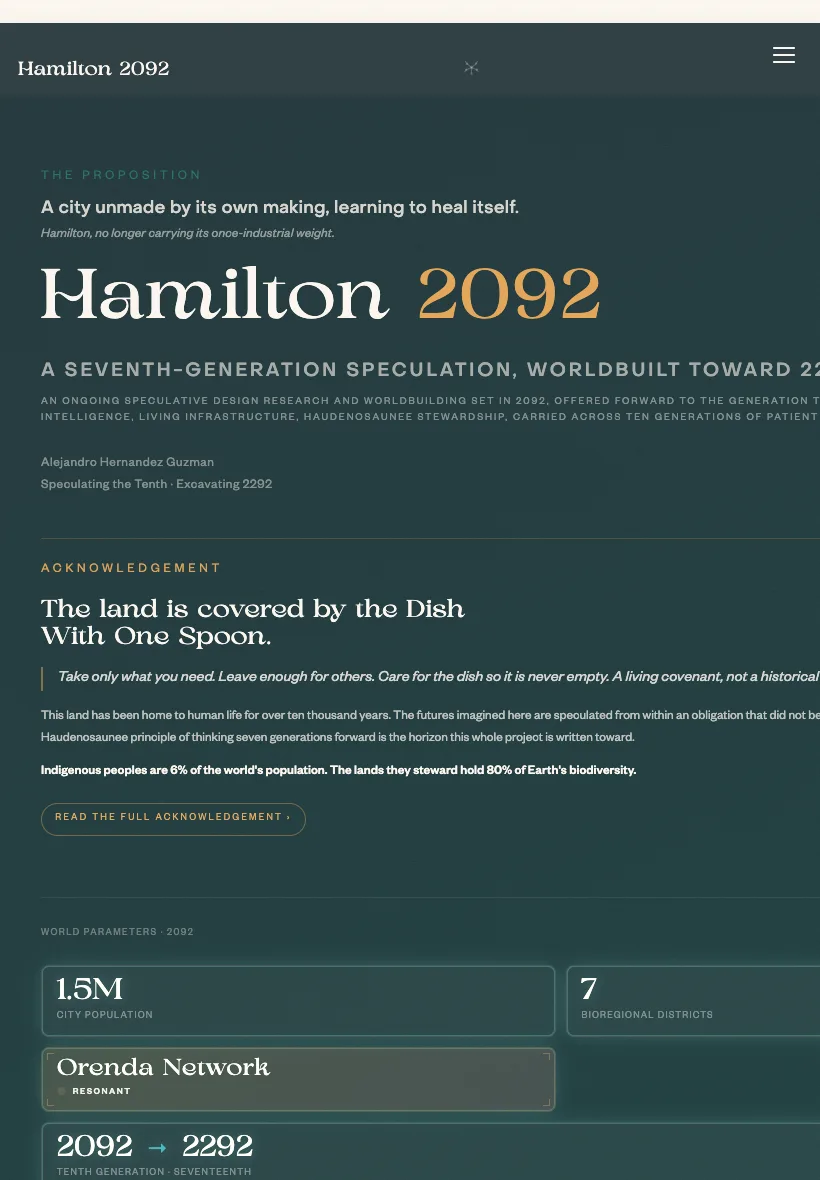
The homepage states the proposition and world parameters before opening the guide.
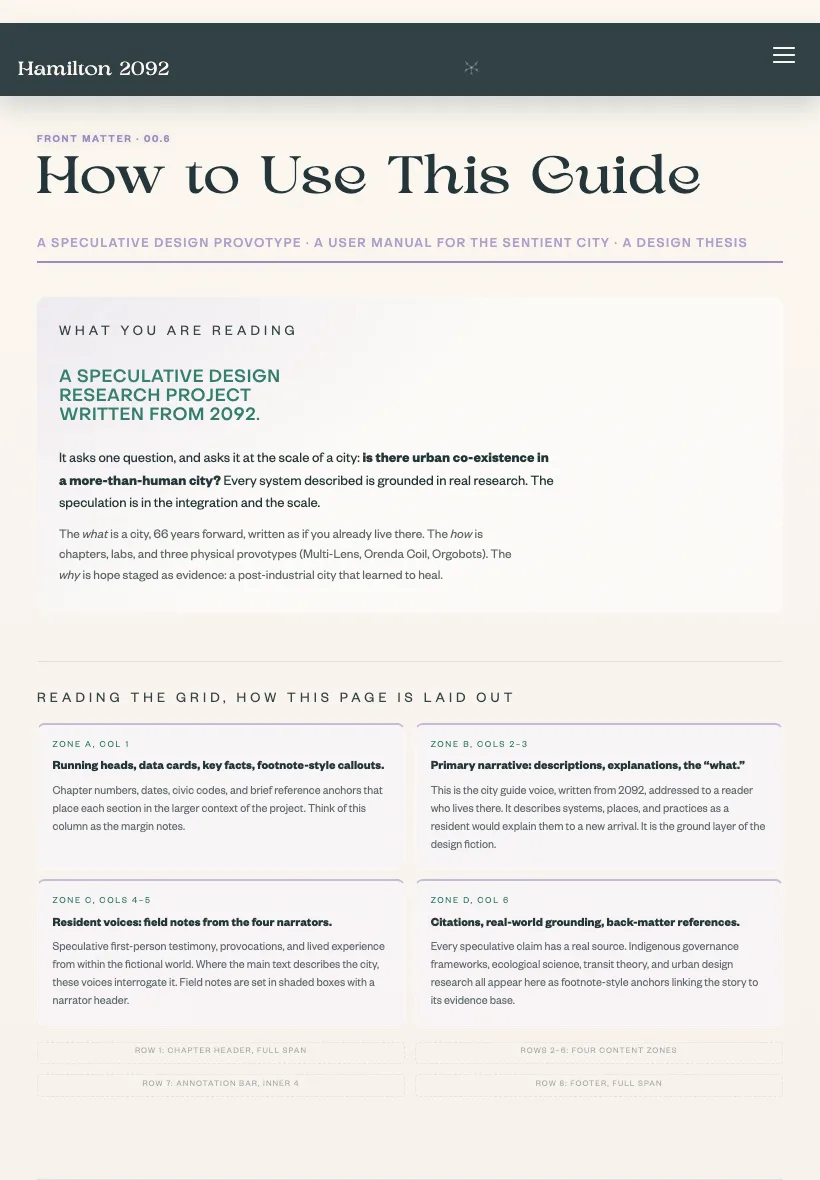
A reading key explains the editorial grid and its layers of evidence.
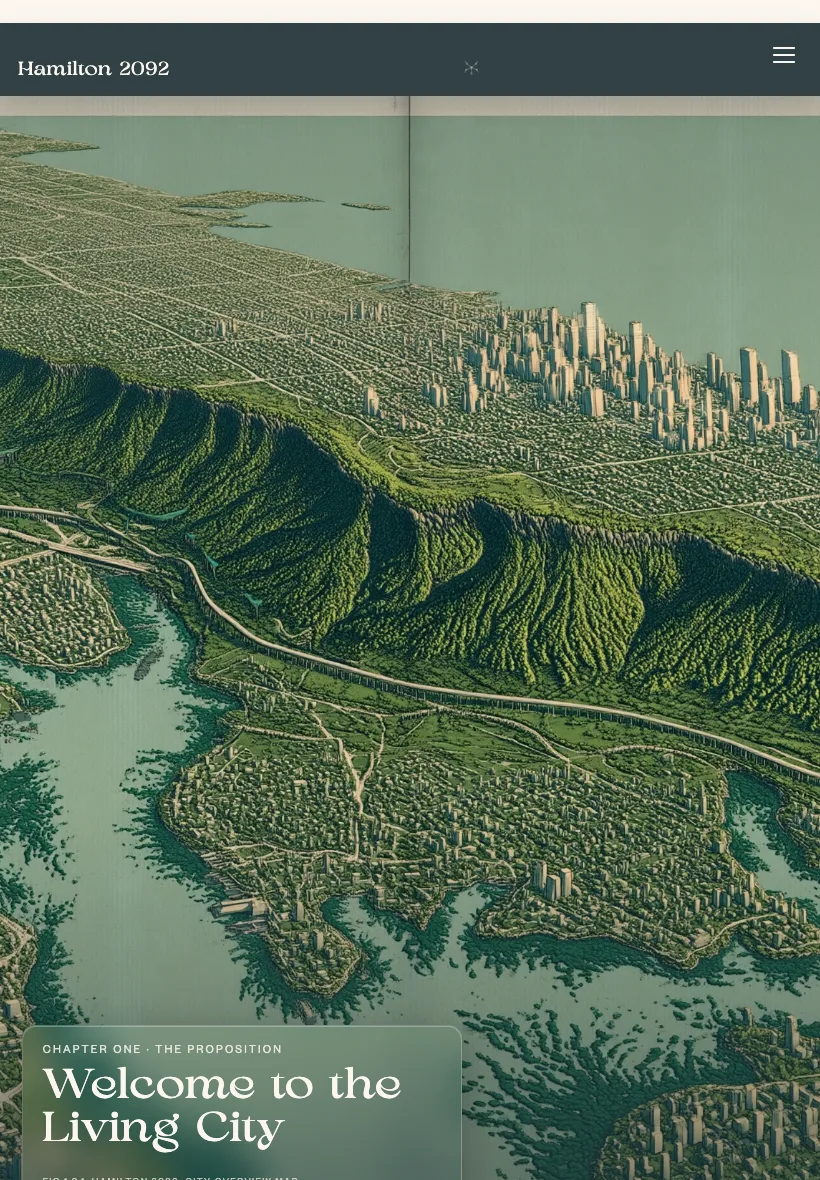
The chapter system shifts between immersive images and grounded information.
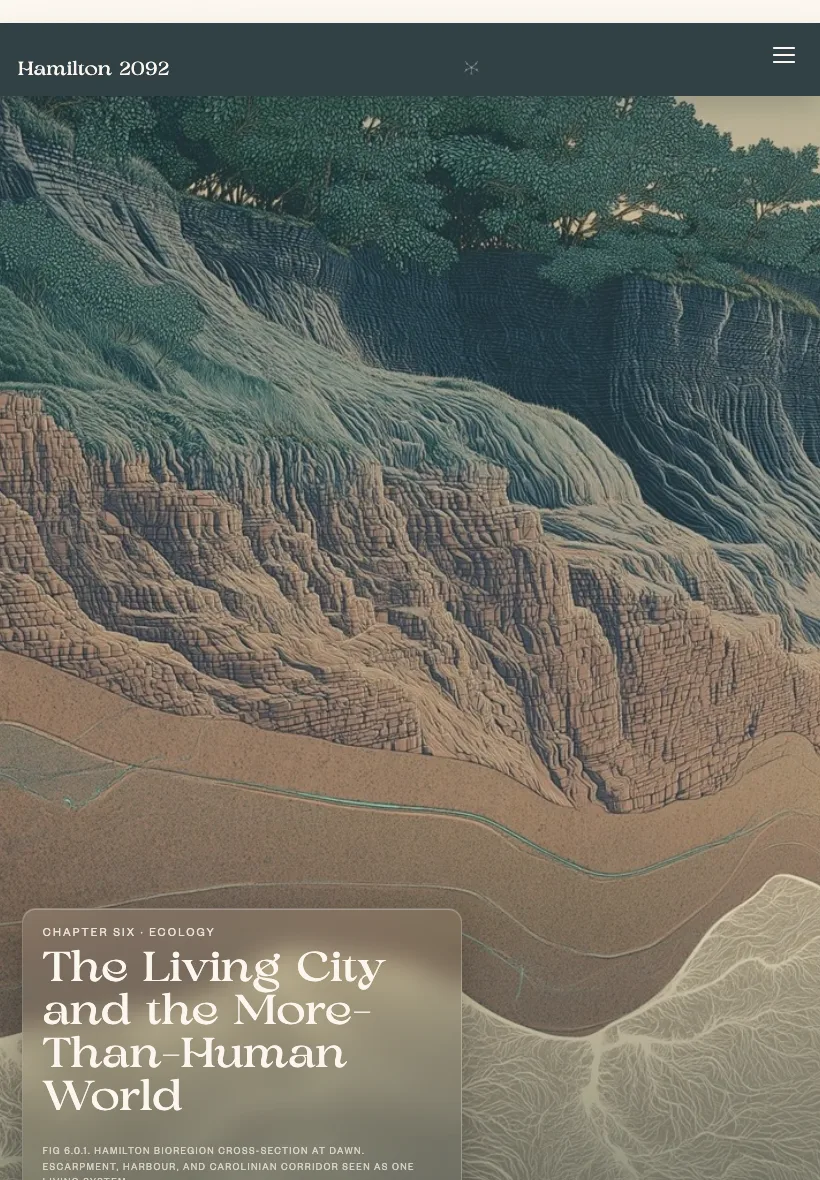
Ecology uses the same system with a distinct chapter atmosphere.
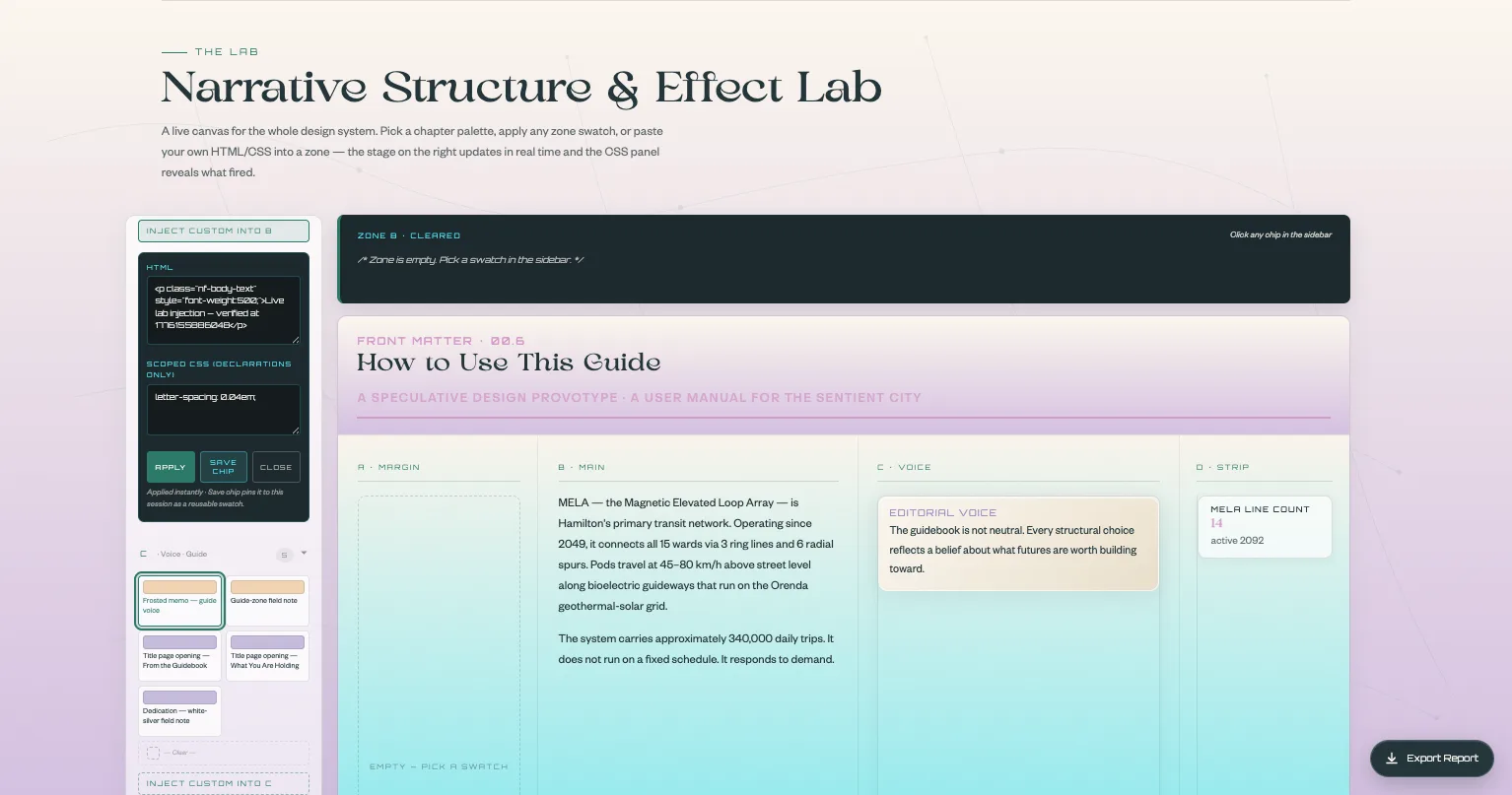
The lab turns narrative structure and visual effects into adjustable, inspectable parts.
07 / Exhibition system
The poster, seven final object labels and 45-second moving-image loop compress the premise into an exhibition language. The film moves from the present-day industrial condition toward the designed world; the models provide material evidence alongside it.
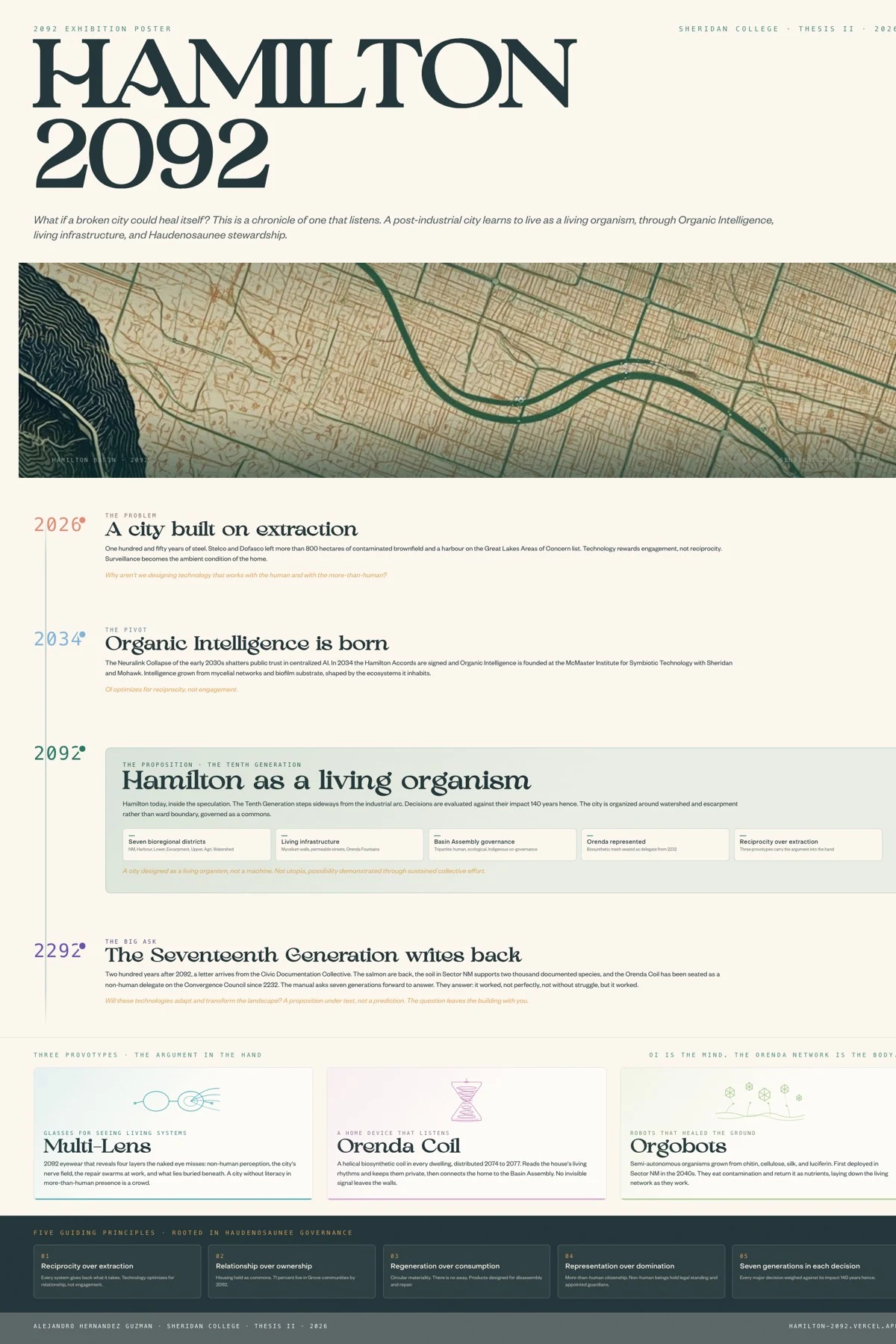
The archive verifies the completed film, poster, labels and object documentation. The reviewed event-photo folder did not contain an unambiguous photograph of the installed Hamilton 2092 display, so no unrelated event image is presented as exhibition-day proof.
What came out of it
An illustrated guidebook, explorable digital world, exhibition graphics, a 45-second moving-image loop and three speculative artifact directions supported by fabricated form studies.
The strongest result is not one isolated image. It is the relationship between research, editorial design, physical studies, moving image and an explorable website—each medium clarifies a different part of the proposition.
Test the guidebook and website with new readers, then prototype one artifact interaction far enough to evaluate behaviour—not only its form and story.
Authorial position
I began with what is happening around us: the way technology advances, what I was reading, and the choices we keep treating as inevitable. Speculation became a way to question those choices and make a positive alternative discussable.
I do not think a design problem has only one solution. Habit, fear, ego and the pressure to keep producing can make us stop looking. Hamilton 2092 asks what a technological future might become if care for people and ecology changed the brief.
Made independently as an audiovisual work, Trees Sway offers a more abstract entry into the same ecological concerns. It remains a supporting micro-case rather than an original Hamilton 2092 deliverable.
Explore Trees SwayProcess & authorship
The concise view: research support helped find and challenge ideas; generative tools supported visual iteration; design and production tools turned those decisions into the publication, models, film and website.
Library tools and language models assisted discovery, questioning and synthesis. Sources and final positions remained subject to human review.
Generated starting points were composited, retouched and directed into a consistent world. They are labelled as speculative visualization, not documentary evidence.
Illustrator, InDesign, Photoshop, SketchUp, After Effects and web code carried the work into tangible and public-facing forms.
This case was rebuilt from a verified, checksum-indexed project archive. Private working files remain offline; only selected public evidence appears here.
Back to the selected fourLet's talk. I'm open to junior experiential, exhibition, spatial, service and product design roles — Toronto-area hybrid, remote, or contract.